The Short Version
Most colleges run Turnitin's AI-writing indicator right inside their learning platform – Canvas, Blackboard, whatever the school runs on – while individual professors and admissions readers reach for spot-check tools like GPTZero, Copyleaks, and Originality.ai when something feels off. So what AI detector do colleges use? Usually several at once, and none of them reliably enough to convict a student on its own. The schools getting this right treat a score as a reason to start a conversation, not a verdict.
I'll be honest: when I started digging into this, I assumed every university quietly ran one magic tool in the background that caught ChatGPT every time. It doesn't work like that. The reality is messier, a little political, and honestly more interesting than the myth.
So let's clear it up. Here's which detectors schools actually use, how much you can trust the scores, and how to read AI writing with your own eyes – which, as it turns out, is still the most reliable detector we have.
The Detectors Colleges Actually Use
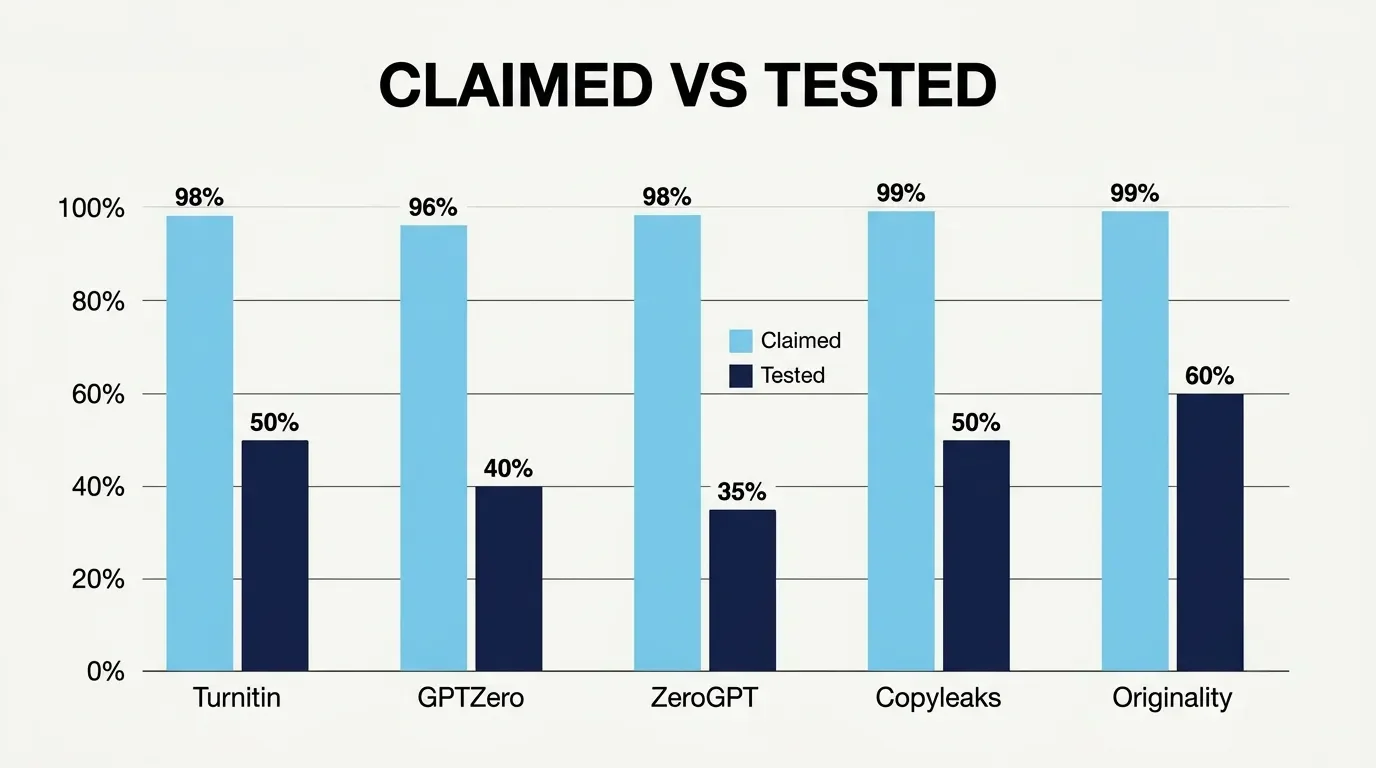
Tool accuracy figures reflect a mix of vendor claims and independent testing as of June 2026; treat any single percentage as a moving target.
Before we go any deeper, here's the lay of the land. I pulled the "claimed" numbers from vendor pages and the "tested" numbers from independent reviews, and I've kept them in separate columns on purpose. That gap is the whole story.
| Tool | Mostly used by | Claimed accuracy | Where it falls apart |
|---|---|---|---|
| Turnitin | Universities, via the LMS | ~98% on raw text | Needs 300+ words; heavy bias against non-native English; institution-only purchase |
| GPTZero | Individual teachers, admissions readers | 95.7% on the RAID benchmark (vendor claim) | Drops to ~40% on "humanized" text; free tier capped at 10,000 words/month |
| ZeroGPT | Students checking their own drafts | >98% claimed | Flagged ~20% of human text as AI in one (contested) study; wildly inconsistent |
| Copyleaks | Multilingual schools, CS departments | 99% claimed | Accuracy slides toward a coin flip on humanized text; credits expire monthly |
| Originality.ai | SEO teams, content agencies | 99%+ claimed | Aggressive tuning can flag plain, structured human writing; no free tier |
Two things jump out at me here. First, almost every advertised accuracy number is measured on raw, untouched AI output, which is the easiest thing in the world to catch. Second, the distance between "claimed" and "tested" is widest exactly where the consequences are most serious. Hold that thought.
Why Turnitin Runs the Show in Most Universities
Turnitin's dominance has almost nothing to do with it being the smartest detector and almost everything to do with location. It already lives inside the tools professors use every day. When you submit an essay through Canvas or Blackboard, Turnitin is right there, no extra login, no copy-paste, no new subscription. Convenience wins. It usually does.
A few things most students never hear:
Whether your work even gets an AI score is up to your school. Administrators control whether the AI indicator is switched on, and some – like Vanderbilt – have turned it off completely.
Turnitin won't even try on short text. It needs around 300 words of continuous prose to generate a score, which means most supplemental admissions essays and discussion-board posts sail right past it.
You can't buy it as a teacher or a student. It's sold to institutions through opaque contracts with no public rate card, and procurement records reported by GradPilot suggest a per-student price somewhere in the low single digits, depending on the school.
As a former law student, I can’t help but tell you to read the fine print, because it’s where the real policy lives. And Turnitin’s fine print says it’s a similarity engine first and an AI guesser second.
How Reliable Are AI Detectors, Really?
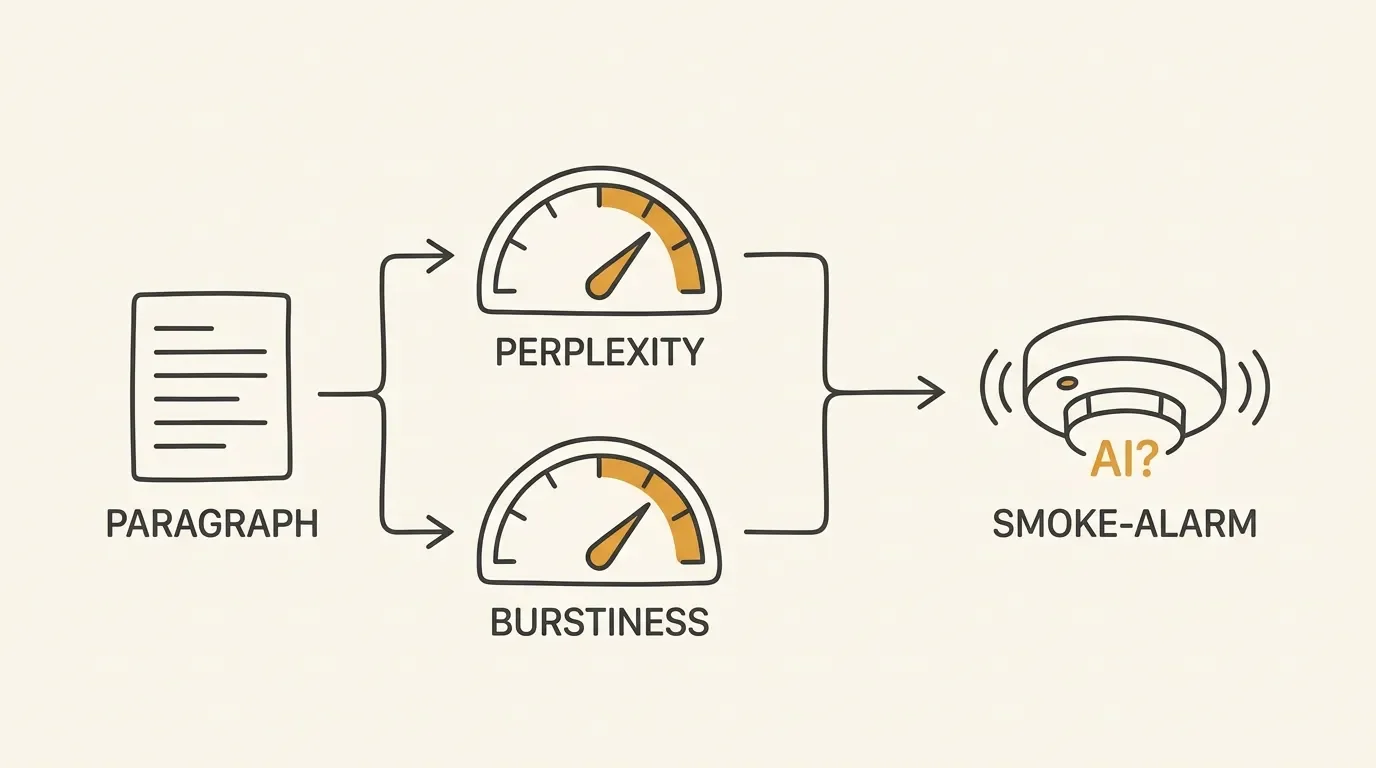
Short version: less than the marketing pages want you to believe, and the way they work tells you exactly why.
Detectors don't read your essay. They never understand a single sentence. They run two statistical measurements: perplexity (how predictable your word choices are) and burstiness (how much your sentence length and rhythm vary). Raw AI text tends to be smooth and predictable, with low perplexity and uniform, evenly sized sentences. So that's what the math hunts for.
See the problem? Plenty of humans write that way too. I like to think of a detector like a smoke alarm that's really an over-sensitive heat sensor. It's not detecting fire. It's detecting warmth, and then assuming fire. Toast sets it off just fine.
Who gets burned by the toast? Non-native English writers, mostly. A landmark Stanford HAI study ran authentic TOEFL essays written by real people through several detectors and watched them falsely flag 61% of them as AI. Essays by native-born US eighth graders came back nearly clean. As a German who writes for a living in my second language, that statistic isn't abstract to me. Clean, structured, "safe" sentences are exactly what you produce when English isn't your first language, and that's exactly the pattern these tools punish.
The schools paying attention already see it. Vanderbilt did the math and figured that even Turnitin's claimed 1% false-positive rate would have wrongly flagged roughly 750 papers a year on their campus – out of the 75,000 they submitted in 2022 – so they turned the feature off entirely. Turnitin itself quietly hedged: if a document scores under 20% AI, it now hides the number behind an asterisk so instructors don't open investigations over low-confidence noise.
And here's the irony that should end the conversation about using these as proof: the moment a student runs AI text through a "humanizer" tool, detection collapses. Independent 2026 testing found GPTZero's accuracy falling from about 95% on raw AI text to roughly 40% on humanized text, and lower still on the toughest samples. The RAID benchmark, the largest independent test of its kind, found every detector it evaluated is easily fooled by exactly this sort of adversarial rewriting. So these tools are good at catching the lazy and basically helpless against the deliberate. That's backwards from how justice is supposed to work.
When a False Positive Turns into a Lawsuit
This is no longer a campus squabble. It's in federal court.
A Yale Executive MBA student was suspended for a year after a teaching assistant ran his exam through GPTZero. He sued, arguing Yale ignored its own warnings about how unreliable these tools are. A federal judge declined to halt the suspension in May 2025, leaving the broader question of algorithmic due process unresolved. At the University of Minnesota, a PhD candidate was expelled over an AI flag on a written exam and filed a human-rights complaint, calling it "a death penalty" for his career. The courts haven't sided with him – a Minnesota appeals court upheld the expulsion in February 2026 – but the case shows how fast a detector flag can escalate into something life-altering.
You don't need a law degree (I have a few unfinished years of one) to see the exposure here. Treating a probability score as forensic evidence is how institutions end up in front of a judge.
GPTZero vs ZeroGPT: I Ran the Test Myself
These two get mixed up constantly, and the names are almost a prank. They are not the same company, not the same quality, not close.
GPTZero is the well-funded one that admissions offices actually take seriously, with detailed sentence-level reports and that headline 95.7% benchmark score. ZeroGPT is the free, ad-supported tool students paste their drafts into at 2 a.m. Academic testing has clocked ZeroGPT falsely flagging around 20% of human text as AI, and other studies put it far higher still – some north of 60%.
I wanted to feel this rather than just quote it, so I ran my own quick test. I grabbed two samples: a piece of a blog post I wrote back in 2021, comfortably before ChatGPT existed, and a fresh paragraph I had a current model generate from scratch.
On the known-human text, GPTZero stayed calm and mostly called it human. ZeroGPT got twitchy and lit up parts of my own 2021 writing as likely AI.
On the known-AI text, both caught it, which is the easy case and not much of a brag.
That lines up with what independent tester Ilam Padmanabhan found running nine tools against his own pre-ChatGPT travel writing: some detectors flagged genuine human work as 65 to 80% AI. Sitting there watching a machine confidently accuse something I clearly remember typing years ago was a genuinely uncomfortable moment. If that's my word against the tool, I'd want a human in the room.
If you're a student using ZeroGPT to "check" yourself before submitting: don't trust it. A scary score might mean nothing, and a clean score guarantees nothing either.
How to Spot AI Writing without Any Tool
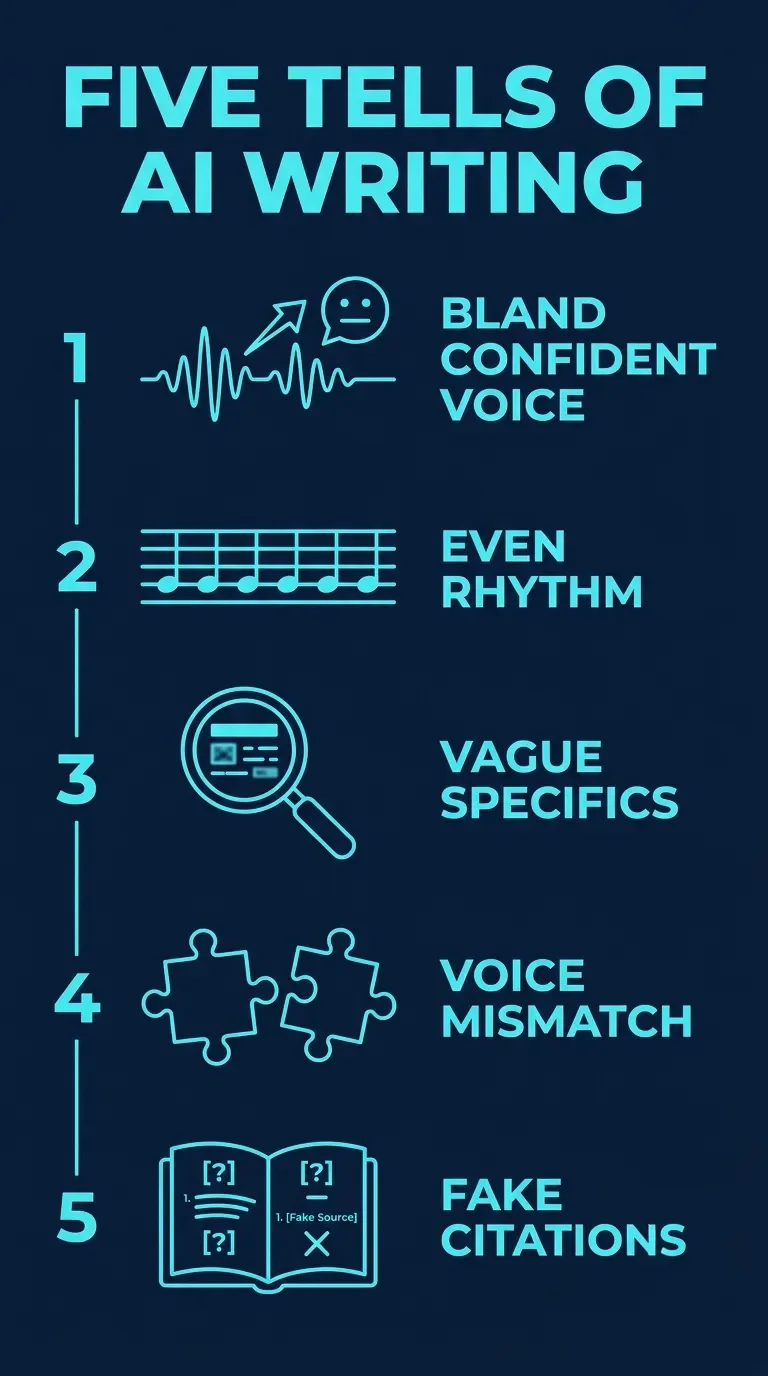
After reading and editing a lot of AI text, you start to feel it before any detector weighs in. No subscription required.
What I personally look for:
A Bland-but-Confident Voice
AI loves a few tells: "delve," "tapestry," "in the ever-evolving landscape," "it's important to note." One or two is nothing. A cluster is a pattern.
Suspiciously Even Rhythm
Real writing lurches. Short punch. Then a long, winding sentence that doubles back on itself. AI tends to march in tidy, same-length rows.
Lots of Words, Little Specificity
It explains the concept of a thing without ever touching a concrete, lived detail. No smell, no number, no actual Tuesday.
A Voice that Doesn't Match the Writer
I think this is a big one for teachers. If a student's discussion posts read like texts and their essay suddenly reads like a McKinsey deck, that contrast is louder than any score.
Fake Citations
Models hallucinate perfectly formatted sources for studies that don't exist. Click the link. Search the author. If the paper isn't real, you have your answer, and it doesn't come from a probability meter.
None of these is proof by itself. Together, they're a much better instrument than the software – partly because a human (at least for now) can tell the difference between "this sounds formal" and "this person cheated." If you want to sharpen your own voice so it never reads as machine-made in the first place, the book that really helps with academic writing is They Say / I Say.
For Educators: How to Check without Falsely Accusing a Student
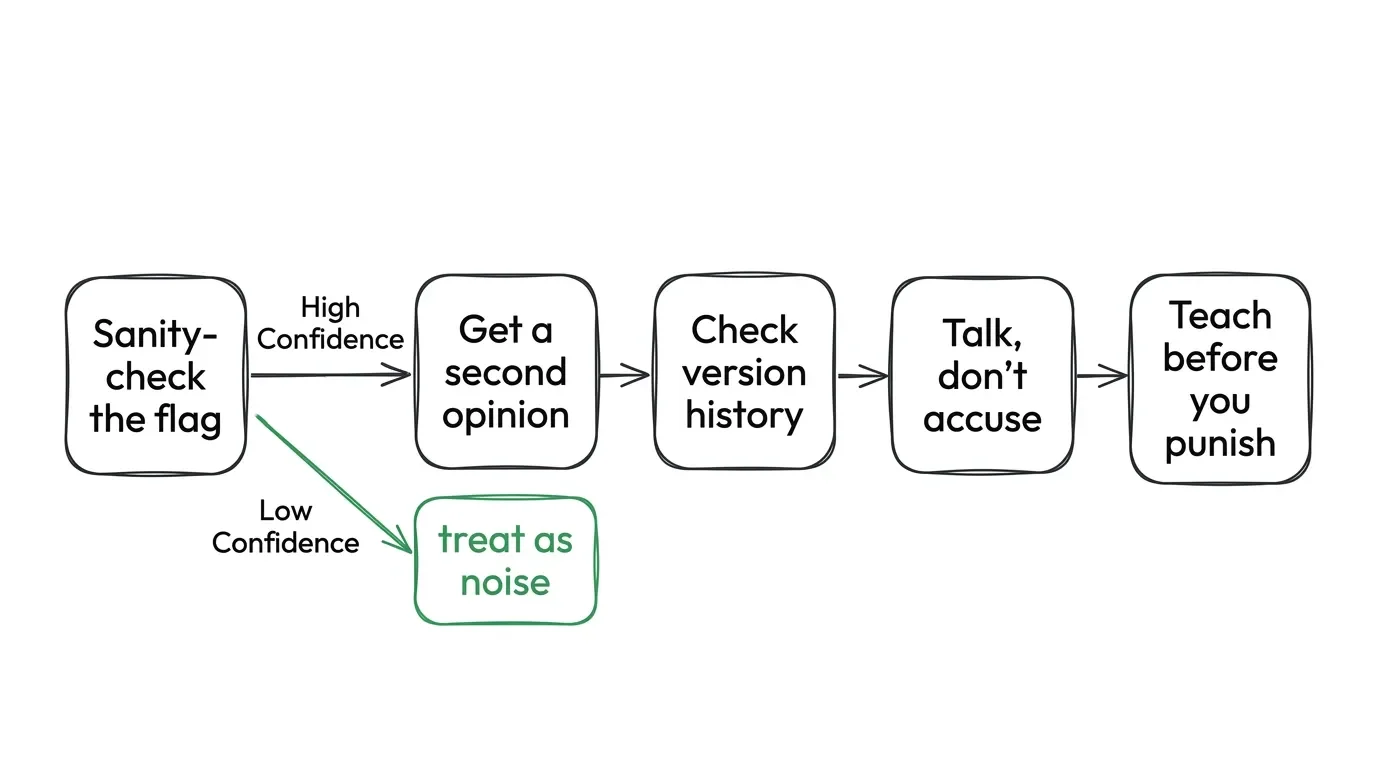
If you teach, this section is the one that hopefully keeps you out of trouble. University teaching centers like the University at Albany lay out a process built around fairness, not gotcha. I am not a teacher by any means – this is just a suggestion for how I would approach it:
Verify the Flag First
Is the piece even long enough to score? Under ~300 words, or full of lists and headers, and you're likely staring at a false positive. A score under 20% (that asterisk) should be treated as noise.
Get a Second Opinion
Run the text through one independent tool outside the LMS. If Turnitin says 90% and GPTZero says 0%, the most likely explanation is that the detector is wrong, not the student.
Look at the Receipts
Version history in Google Docs or Microsoft 365 tells you a lot. Steady, messy drafting looks human. A 3,000-word essay that appears in one paste does not. Check the citations for hallucinations while you're there.
Talk, Don't Accuse
Open with "this reads differently from your earlier work, walk me through how you wrote it," not "you cheated." Ask for drafts, notes, outlines. A student who did the work can usually explain it in about thirty seconds.
Teach Before You Punish
If something's genuinely wrong, a rewrite for reduced credit often serves the actual goal – learning – better than immediately escalating to a formal misconduct case, at least on a first offense.
My psychology background nags at me here: the cost of a false accusation isn't just a grade. It's trust, anxiety, and a student who now spends more time fearing the detector than writing. That's a bad trade.
For Students and Applicants: Do College Admissions Check for AI?
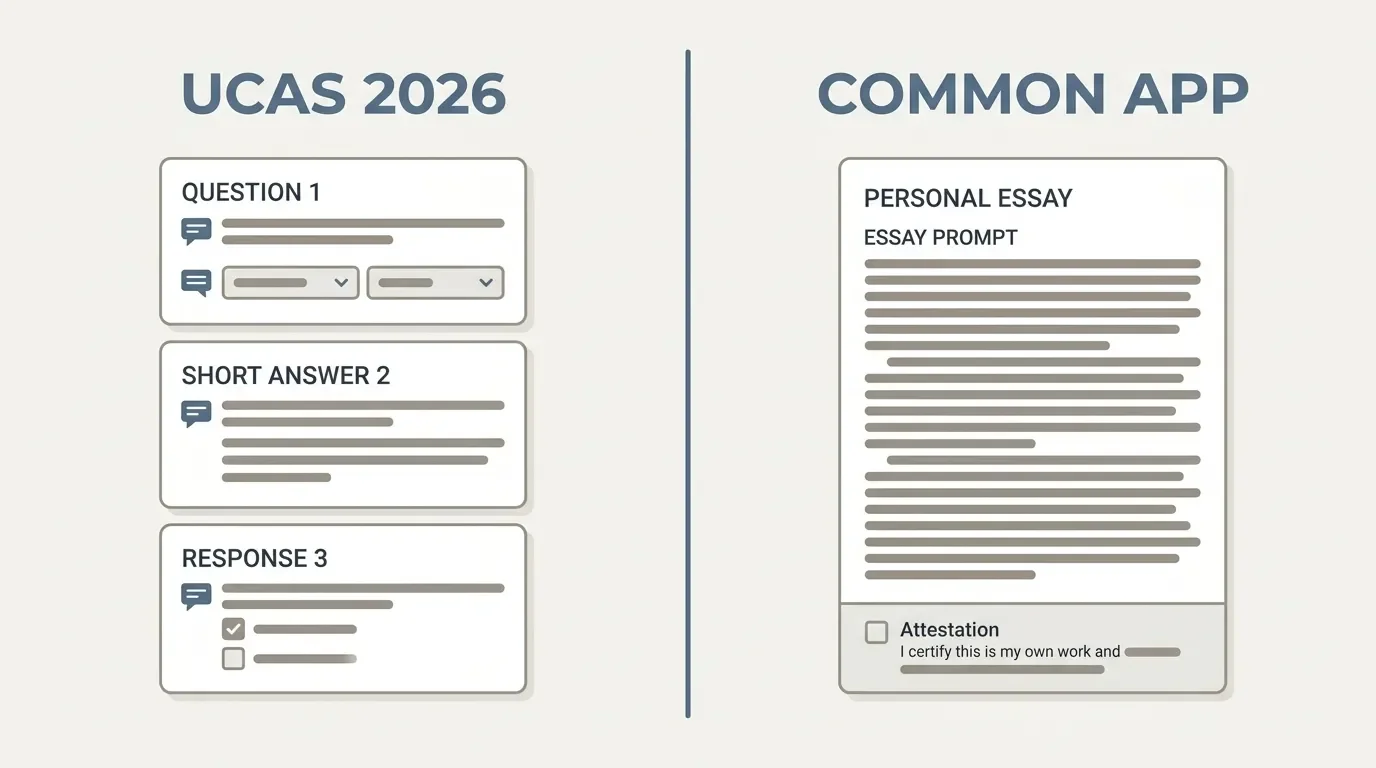
Short answer: sometimes, but probably not the way you fear, and the system is openly split on what to even do about it.
The two big application platforms went opposite directions. In the UK, UCAS scrapped the single open-ended personal statement for the 2026 cycle, splitting the same 4,000-character limit across three structured, specific questions that are simply harder for a model to fake convincingly. The US Common App, meanwhile, kept its 650-word essay and is relying on an honor-style attestation where you promise you didn't use AI to write it.
There's also a technical blind spot working in applicants' favor: those short supplemental essays are usually under Turnitin's 300-word floor, so automated scanning often can't run on them anyway. What does that leave? Experienced human readers. And seasoned admissions officers are blunt about it: an AI-written essay reads as generic and forgettable, which is its own kind of rejection. The risk isn't really "a detector catches you." It's that the essay is boring, and boring doesn't get you in.
My honest advice: use AI to brainstorm or tidy grammar if your school allows it, but the story has to be yours. A real, specific, slightly imperfect human voice is the one thing the models still can't counterfeit. If you want to get the line between helpful and dishonest right, Ethan Mollick's Co-Intelligence is the clearest guide I've found to using AI as a collaborator without handing it the wheel.
The Verdict
If you take one thing from all this: AI detectors are signals, not verdicts. Turnitin will keep being the default because it's already everywhere. GPTZero and Copyleaks will keep doing useful spot checks. But the false positives are real, the bias against non-native writers is documented, and the courtroom losses are piling up. Anyone using a single score to end someone's semester is doing it wrong.
The most trustworthy detector in 2026 is still a careful human who knows the student's voice, checks the drafts, and reads the citations. The software just tells you where to look.
If you want to go deeper on staying safe and sane around these tools, I'd start with my guide on whether ChatGPT is safe to use in 2026, and if a detector or platform is glitching on you mid-submission, my ChatGPT Network Error walkthrough might save you some time and nerves.
Have you been on either side of this – flagged for something you actually wrote, or stuck judging a flag as a teacher? I'd really like to hear how it shook out in the comments below, especially the cases where the tool got it confidently, completely wrong.
And if you'd rather get this kind of teardown before everyone else does, I send a plain-English tech newsletter a few times a month on which AI tools hold up under real testing and which quietly fall apart the second they meet messy human writing. You can grab it here.

FAQ
-
Yes, Turnitin's AI indicator is trained to flag output from the major models, and it shipped an update in 2026 aimed at the newer ones. But as covered above, accuracy drops hard on text that's been pushed through a humanizer or written by models like Claude that vary their phrasing on their own. Read a hit as a reason to look closer, not as proof.
-
It can. If you let an assistant rewrite whole sentences, the tidy, low-perplexity result is exactly the pattern detectors punish, even though the idea was yours. Light grammar and spelling fixes are usually fine; wholesale rephrasing is where you start to look machine-made to the math. Keep your edit history so you can show the thinking was your own.
-
There isn't a universal number, and anyone quoting a hard figure is guessing. It depends entirely on your school's policy, which runs from "none, ever" to "fine for brainstorming." Turnitin blurs it further by hiding any score under 20% behind an asterisk, so a low reading might never even reach your professor.
-
Unfortunately, yes, and it has already happened. As I covered, students at Yale and the University of Minnesota faced suspension and expulsion largely off the back of detector flags, and both pushed back in court. It's still rare, but it's the whole reason no school should treat a score as the final word.
-
Your strongest defense is a paper trail you build before there's ever a problem. Draft in Google Docs or Word so there's real version history, hang on to your notes and outlines, and be ready to explain your argument out loud. A genuine author can usually walk through their own reasoning in seconds, and that messy, human process is hard to reverse-engineer after the fact.
-
Some do, but unevenly. Copyleaks markets detection across 30+ languages and Turnitin's AI report supports English, Spanish, and Japanese, while most consumer tools are still tuned for English first. Given the non-native English bias from the Stanford study, I'd be extra skeptical of any score on translated or multilingual work.
-
A little, but not enough to stake a grade on. Paid tools like GPTZero and Originality.ai post better benchmark numbers than free ones like ZeroGPT, and in my testing the paid side stayed calmer on genuine human text. The catch is that every one of them, paid or free, comes apart the moment the text is deliberately humanized.



I've used Gemini image generation almost daily for months. Here's how to create and edit images, what the free limits really are, and my best prompts.