
The Best MagSafe Wallets in 2026 – Here's the One I'd Buy
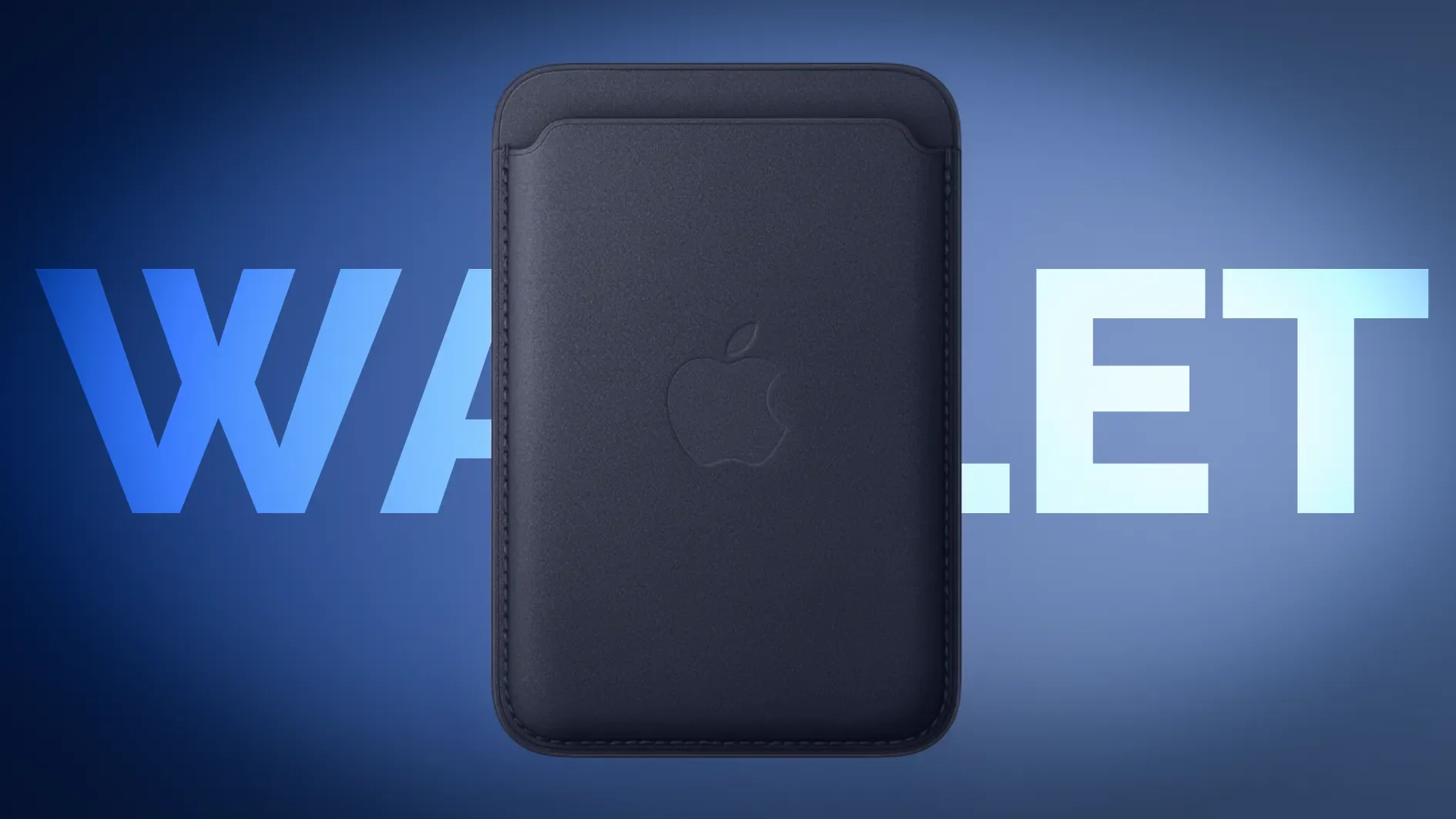
I've had a MagSafe wallet stuck to the back of my iPhone for more than five years now. Same spot, every single day, across three different phones. So when friends ask me which one to buy in 2026, I don't really have to think about it – I just pull mine off the phone and start talking.
Here's the part that surprised me, though. After years of defaulting to Apple's own wallet, I no longer think it's the obvious pick. Apple quietly discontinued its leather wallet back in 2023 and now sells only the $59 FineWoven version, and a handful of cheaper rivals now match or beat it on the stuff that actually matters day to day.
I tested the field the way I test everything: over weeks and months, in real pockets, on real walks, not on a spec sheet. Below is what I'd buy, why, and the honest trade-offs.
I'll be upfront about something: a wallet is a deeply personal piece of gear. The best one for you hinges on whether you're a two-card minimalist or someone who treats the back of their phone like a filing cabinet. So I've sorted my picks by the kind of person you are, not by a single trophy. Stick with me and you'll know which one is yours by the end.
The Verdict: The Best MagSafe Wallets in 2026
If you want the answer without the scrolling, here it is.
Best overall / best value
I name it the best overall MagSafe wallet for 2026, and at roughly $25 I think it's hard to argue. Vegan leather, five card slots with an ID window, and a built-in stand. Buy it if you want the most wallet for the least money. Skip it if you need a leather feel or a built-in tracker.
View on Amazon →Best premium leather
Real Horween leather, a rechargeable Find My tracker baked in, and a build that ages instead of fraying. Buy it if you care how a wallet looks and feels in year three. Skip it if $89 feels steep for a card holder.
View at Nomad →Best value with a tracker and a stand
Around $40 with a rechargeable Find My card, a kickstand, and RFID blocking. Buy it if you want live tracking and a propped-up phone for video calls. Skip it if you want the slimmest possible profile.
View on Amazon →Best for Apple purists
The cleanest ecosystem experience, with Find My built straight into the phone and no battery to babysit. Buy it if you live entirely in Apple's world. Skip it if you want real-time tracking, a stand, or leather.
View on Amazon →Best tracker and stand, Apple-approved
The first third-party Find My wallet Apple sells in its own stores, with a foldable stand and a rechargeable tracker rated for about six months. Buy it if you want a genuine tracker and a versatile stand with Apple's blessing. Skip it if you carry more than two cards or need RFID blocking.
View on Amazon →Best budget stand alternative
Satechi Vegan-Leather Wallet Stand
About $40 for a four-card vegan-leather wallet that folds into a stand and adds NFC pass-through. Buy it if you want a leather-look stand wallet for less. Skip it if you want any kind of tracker.
View on Amazon →Best for card hoarders
$129 of aluminum that holds seven cards (more with add-ons) and fans them out at the push of a button, with Find My available via an add-on Finder Card. Buy it if you carry a real stack of cards and want them built like a tank. Skip it if you want something slim, cheap, or with tracking built in.
View on Amazon →Notice I didn't crown a single "best for Find My," and that's deliberate. There are actually two completely different things hiding under that label, and mixing them up is how people end up disappointed. More on that in a minute.
How They Stack Up
Here's a quick side-by-side before we get into the why.
| Wallet | Price (USD) | Material | Cards | Find My | Stand/grip | Best for |
|---|---|---|---|---|---|---|
| Apple FineWoven | $59 | FineWoven textile | 1–3 (2 comfortable) | Native, passive (no battery) | No | Apple purists |
| Nomad Leather Mag Wallet | $89 | Horween leather | 1–4 (3 practical) | Built-in rechargeable tracker | No | Premium leather + real tracking |
| ESR Geo | ~$40 | Vegan leather | 3–5 (disputed) | Rechargeable Find My card | Yes (kickstand) | Value + tracker + stand |
| MOFT Find My Wallet Stand | ~$50 | Vegan leather (MOVAS) | 2 | Built-in rechargeable tracker | Yes (foldable stand) | Apple-sold tracker + stand |
| ESR Aura | ~$25 | Vegan leather | 5 (incl. ID window) | None | Yes | Budget all-rounder |
| Satechi Vegan-Leather Wallet Stand | ~$40 | Vegan leather | 4 | None | Yes | Budget stand + NFC pass-through |
| Ekster Cardholder Pro | $129 | Aluminum | 7 (more with add-ons) | Via add-on Finder Card | Optional add-on | High capacity, modular |
A Quick Primer on How These Actually Work
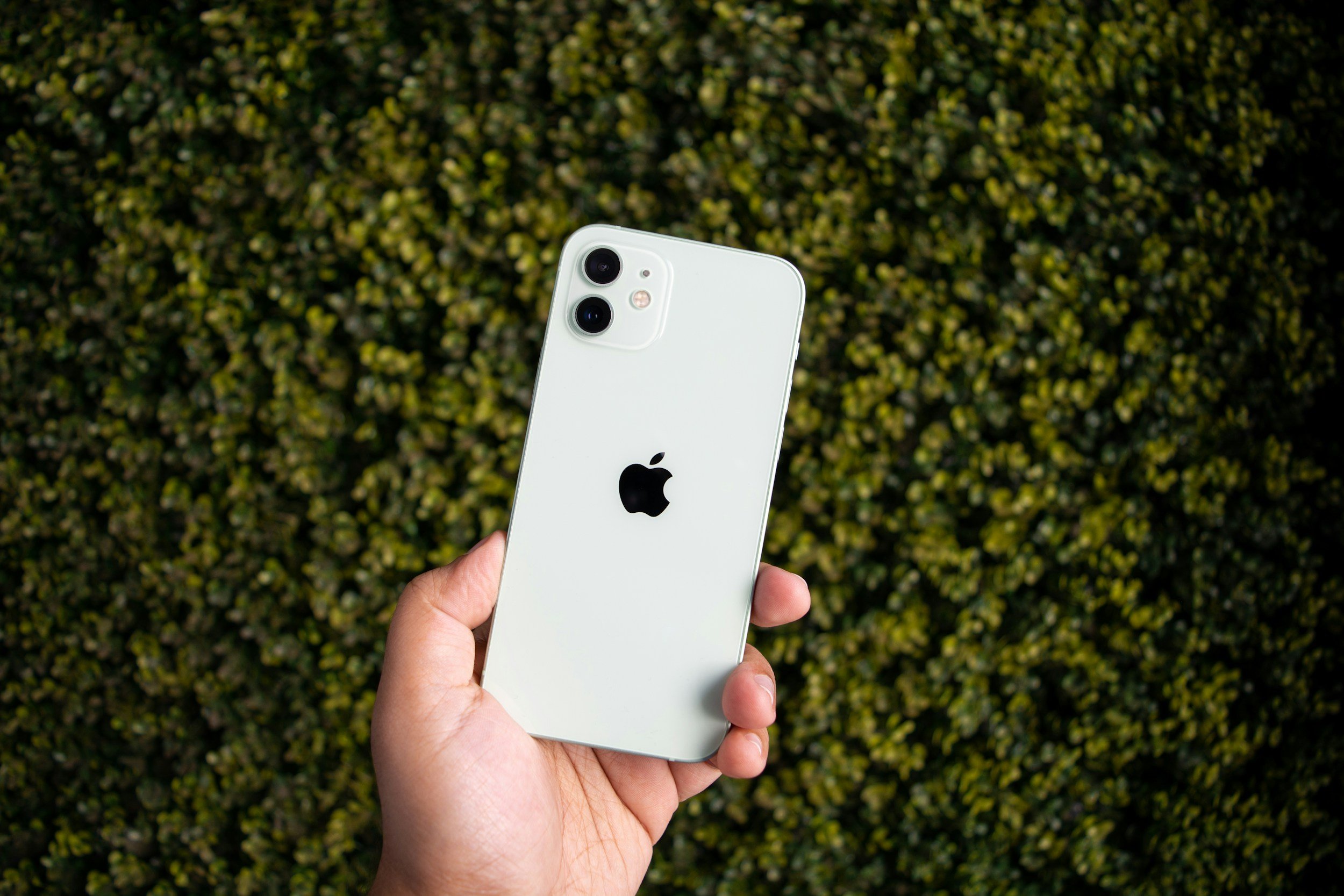
If you're new to all this, here's the short version. MagSafe is the ring of magnets Apple started building into the back of every iPhone with the iPhone 12 in 2020, circled around the wireless-charging coil so accessories snap into the exact same spot every time. A MagSafe wallet is just a card holder with a matching magnet array. It clings to that ring, sits flat against the back of the phone, and pulls off when you need a card or want to charge.
That's the entire concept. Where these wallets actually diverge is in three things: how strong the magnets are, what the wallet is made of, and whether it can help you find it when it wanders off. Get that trio right and the rest is taste. Get it wrong and you've got a card holder that slides off in your pocket and looks tired in a month. Keep those three levers in mind as we go – magnets, material, tracking – because every pick below lives or dies on them.
How I Tested (and What I Actually Carry Now)
I'm not a lab. I'm a guy who works part-time at an electronic store, edits videos and shoots photos for this blog, and walks a lot around Cologne. That's the test.
My daily driver for the last nearly five years was mainly Apple's second-generation black leather MagSafe wallet – the real-leather one with Find My built in, bought before Apple pulled leather from its lineup in 2023. I tried quite a few different brands over the years (they are all included in this test) but always came back to this one. Here's a detail worth sitting with: even that Find My was only the passive, last-detached kind – it logs where the wallet slipped off, not where it is right now. So my "premium Apple wallet" looked and felt fantastic, yet it still couldn't actually tell me where my cards were – and then Apple replaced it with FineWoven instead of leather. That one-two punch is exactly why I stopped treating the Apple logo as a shortcut to the best choice.
On top of that, I've spent the last few weeks living with Apple's FineWoven wallet and the ESR Aura, swapping them across my iPhone 16 Pro Max, an old 13 mini, and my wife’s “old” 14 Pro. Different magnet rings, different grip, different pocket behavior. I carried two to three cards in each – a debit card, my driver’s license, and occasionally my health insurance card – and paid attention to the boring stuff: Did it hold on a jog? Did it survive being yanked out of skinny jeans? Did the cards start sliding after a month?
Apple FineWoven Wallet – Best for Apple Purists
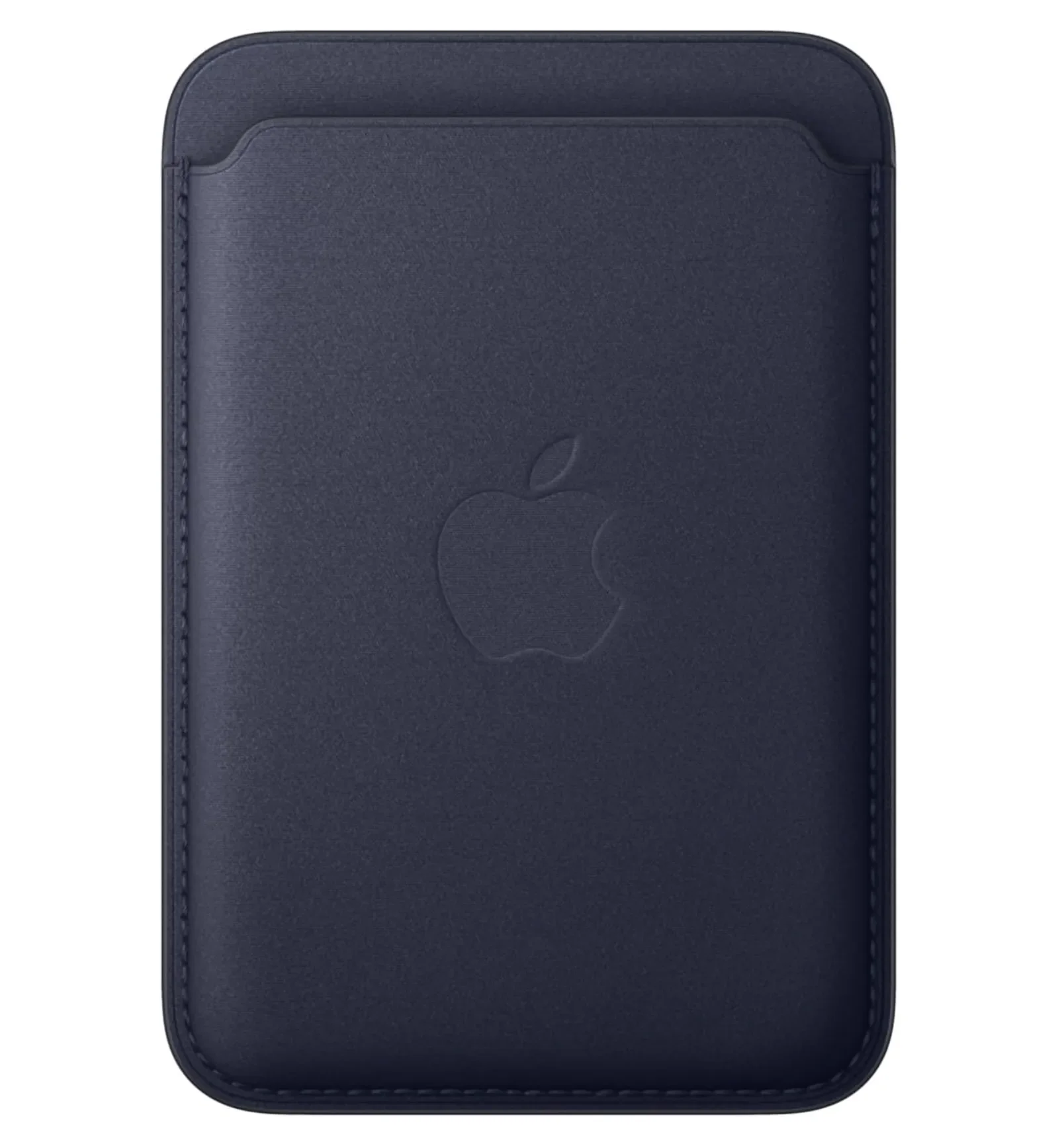
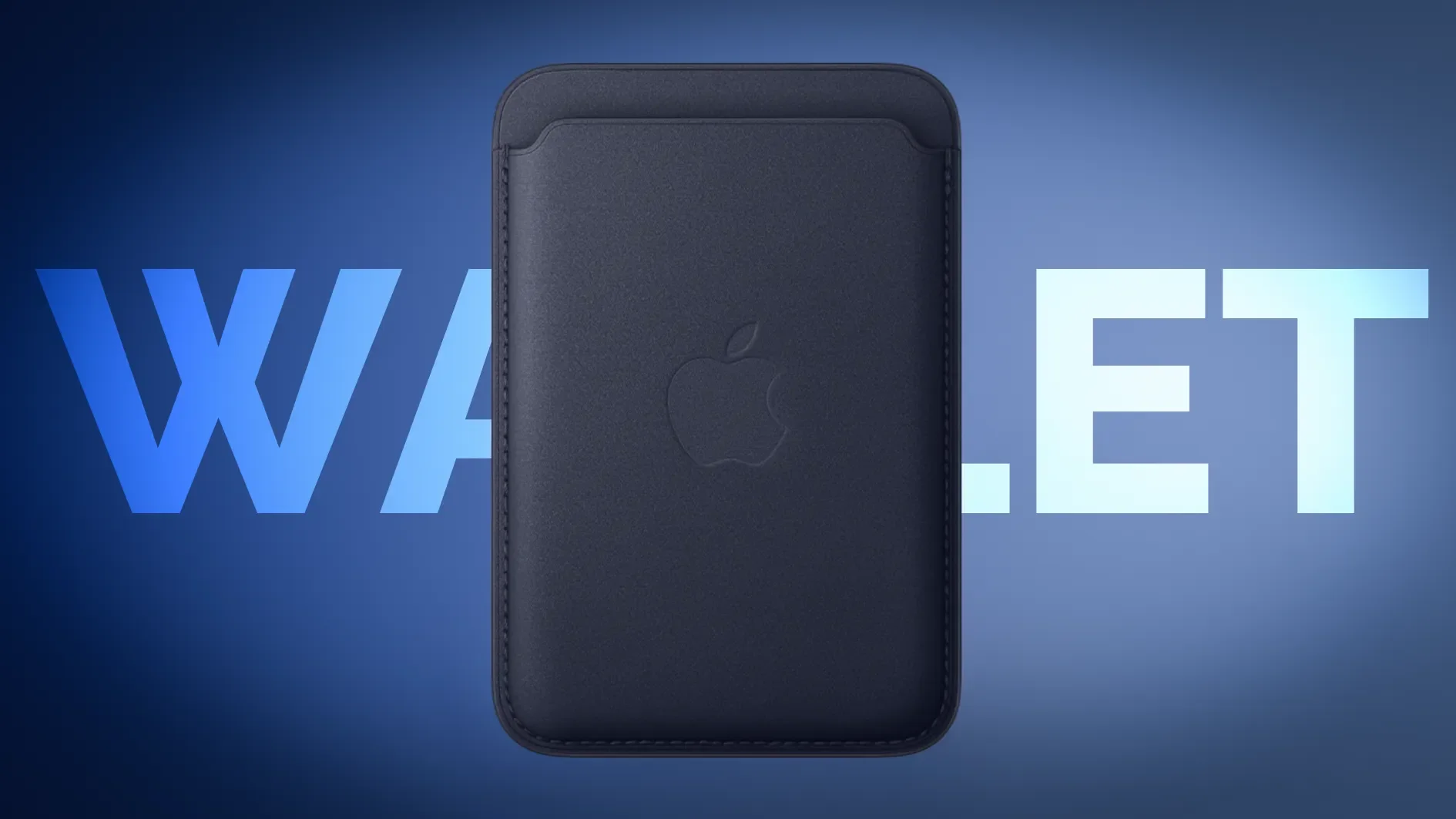
Let's start with the one most people assume is the default. The Apple FineWoven Wallet runs $59, and its single best trick is that Find My is built directly into your iPhone – no separate tracker, no battery, nothing to recharge. You attach it, tap through a quick setup, and your phone will warn you if the wallet ever detaches.
That sounds great until you understand what it actually does, which I'll cover below. The short version: it remembers where it last fell off, not where it is right now.
The material is the other catch. FineWoven is Apple's woven textile replacement for leather, and it got hammered for scratching and fraying – so much so that Apple killed the FineWoven cases in 2024, even as it kept the wallet and refreshed it in 2025. Mine hasn't fallen apart, but it picks up shine and scuffs faster than my old leather one ever did. Capacity is tight, too. Apple rates it for three cards, but two is the comfortable number; cram in a third and you can feel the magnet hold get a little nervous.
Living with it, the FineWoven texture is the thing I keep circling back to. It's fine. Not bad, not special – a faintly suede-ish weave that looks sharp for about three weeks and then starts logging every fingernail and key it has ever met. My old leather wallet did the opposite, softening into that lived-in look I actually wanted. Apple refreshed the FineWoven wallet in 2025, so newer stock may hold up a little better, but I wouldn't bet too much on a fabric Apple has already walked back from once.
My take: clean, slim, genuinely the simplest setup if you never want to think about it. Just don't buy it expecting a tracker or a material that ages gracefully. One honest tip, though: if you can still track down a genuine Apple Leather Wallet with MagSafe – old stock at a reseller like Amazon or a clean used one in good shape – I'd grab that over the FineWoven without hesitation. Aim for the second-generation version Apple added in late 2021: it built in Find My support, so you get the same last-known-location alerts the FineWoven offers, just wrapped in leather that ages instead of fraying. Only the original 2020 release skipped Find My entirely, so check before you buy – and either way it's the passive, last-detached kind of tracking, not a live tracker like Nomad's.
Nomad Leather Mag Wallet – Best Premium Leather
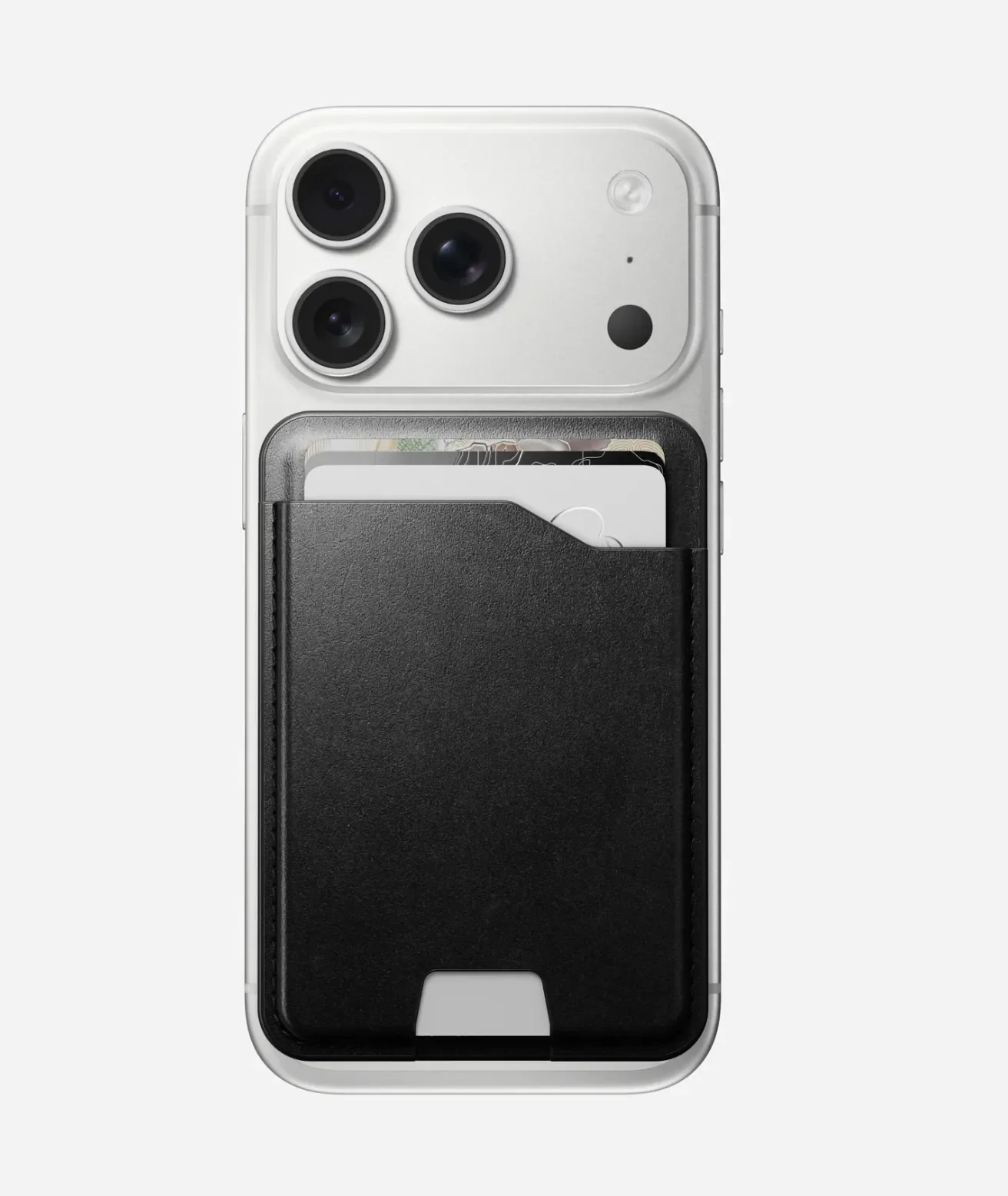
If the thing you miss from Apple's old wallet is leather, this is where I'd go. Nomad uses Horween leather,packs in a rechargeable Find My tracker, claims around five months of battery, and recharges wirelessly on any Qi or MagSafe pad. It holds one to four cards, though like every slim wallet, three is the realistic number.
This is the one I'd hand to someone who notices how a wallet feels. Leather patinas; FineWoven just wears out. The trade-offs are honest ones: it's the priciest mainstream pick, the card slot runs a touch tight, and the "play a sound to find it" feature only works within about 150 feet – beyond that you're just looking at a location on a map, not chasing a chirp.
The numbers back up the hand-feel. Nomad lists it at 96 by 66 by 9 millimeters and 47 grams – slim enough that I forgot it was on the phone, dense enough that it feels like a real object instead of a sticker. The tracker is the part I'd genuinely use. Unlike Apple's passive chip, this one actually pings the Find My network, so if it slipped out of my coat on a train I could still watch it move on the map. The price you pay is a small ritual: every few months you drop it on a charger to top off the battery, the same way you'd remember to charge an AirTag. Not a dealbreaker. Just a thing you sign up for.
My take: the wallet I'd buy with my own money if I wanted something that still looks good in 2028.
ESR Geo – Best Value with a Tracker and a Stand
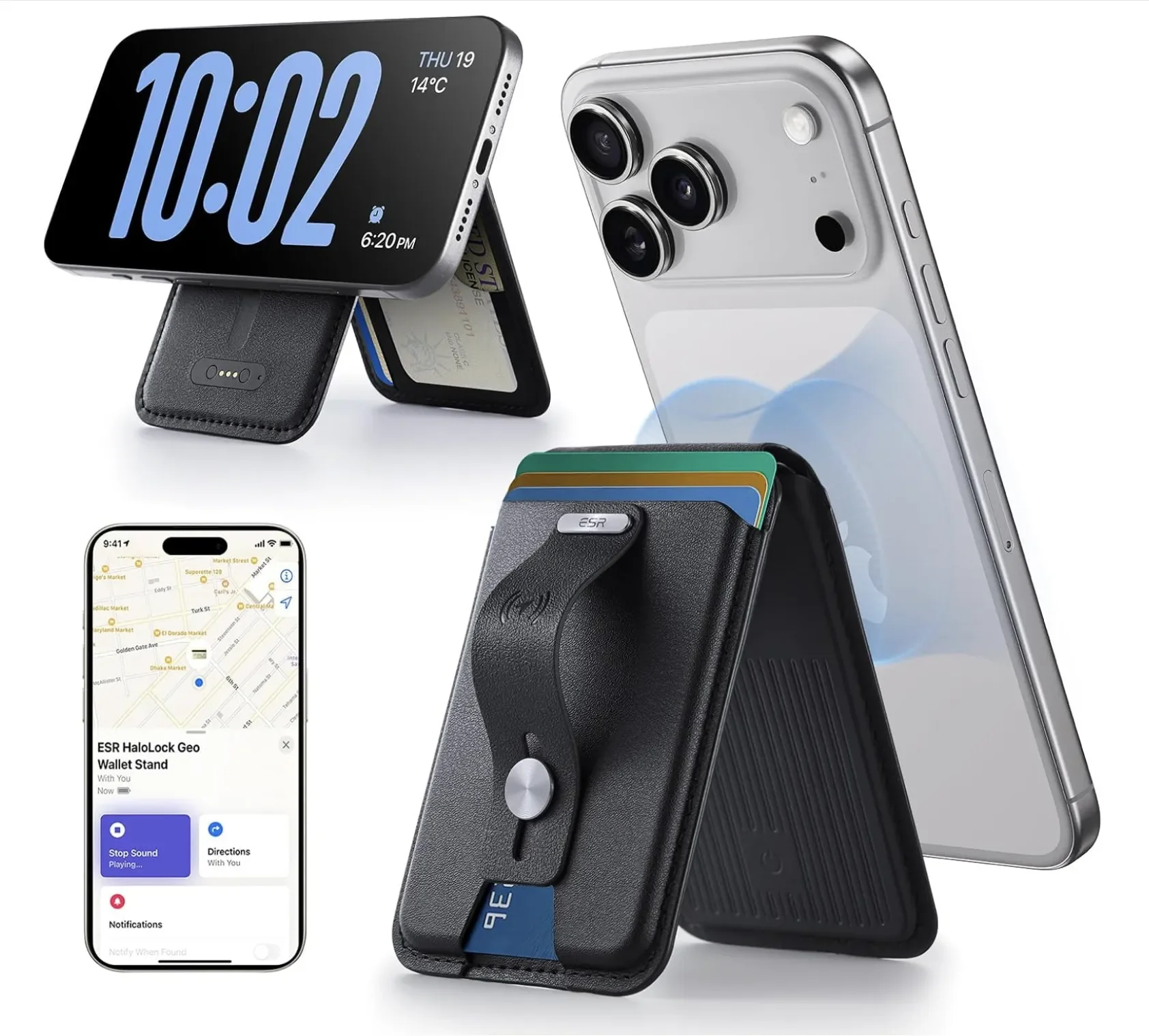
Here's the one that quietly changed my mind about spending $59 on Apple's wallet. The ESR Geo gives you a rechargeable Find My card, a kickstand-slash-grip, and RFID blocking. For someone who films talking-head clips and takes a lot of FaceTime calls, that built-in stand is the feature I didn't know I wanted until I had it.
Battery life is where I'd manage expectations. ESR's listing advertises up to six months, but myself and other independent reviewers land closer to three, and it recharges through a slightly annoying proprietary magnetic USB-C pin. Card capacity is also genuinely unclear – ESR says five, but in my testing it was closer to three, depending on how thick your cards are. I'd treat it as a three-card wallet that occasionally surprises you.
What sold me was a long edit day. I propped the phone up on the kickstand, shot a few reference clips for a video, and the wallet was right there with my transit card when I headed out – no second accessory, no separate AirTag to track. The grip doubles as a finger loop for one-handed scrolling, which sounds gimmicky right up until you're holding a 16 Pro Max over your face in bed. RFID blocking is built in too, though I'll be honest about how much that actually matters in a minute. The one daily annoyance is that recharge pin: it's proprietary, so it's yet another odd little cable to keep track of.
My take: still the most features per dollar – a rechargeable tracker, a stand, and RFID blocking without the premium price.
MOFT Find My Wallet Stand – Best Tracker-and-Stand You Can Buy from Apple
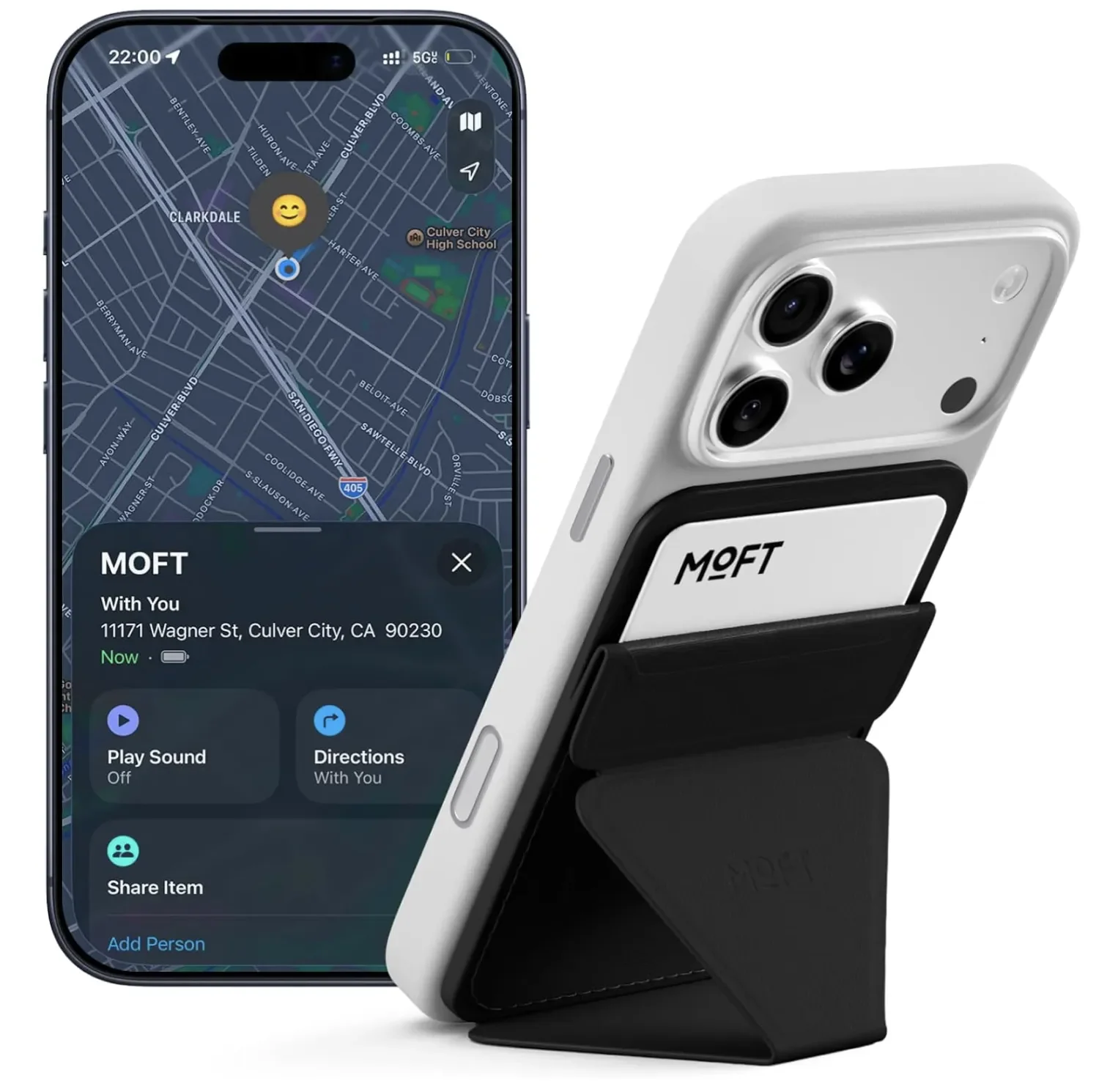
This is the wallet Apple itself decided to sell, and that's the headline. The MOFT Find My MagSafe Wallet Stand is the first third-party trackable wallet stocked in the Apple Store, which means its tracking is the real, fully baked Find My – rechargeable and network-wide, not Apple's passive last-seen trick. The MOFT Find My Wallet Standruns about $50, holds up to two cards, and claims roughly six months per wireless charge.
What you're really paying for is the origami stand. It folds into portrait, landscape, and a low floating angle, which makes it the most flexible kickstand in this roundup – handier for filming than the ESR Geo's single prop. The catches are real, though: it only takes two cards, there's no RFID blocking on the trackable version, and the stand can be stiff to flick out and slides side to side a little once it's propped up.
My take: the pick that genuinely rivals the ESR Geo – grab it if you want a real tracker, a versatile stand, and the reassurance that Apple vouched for it, just not if you carry a thick stack of cards.
ESR Aura – Best Budget All-Rounder
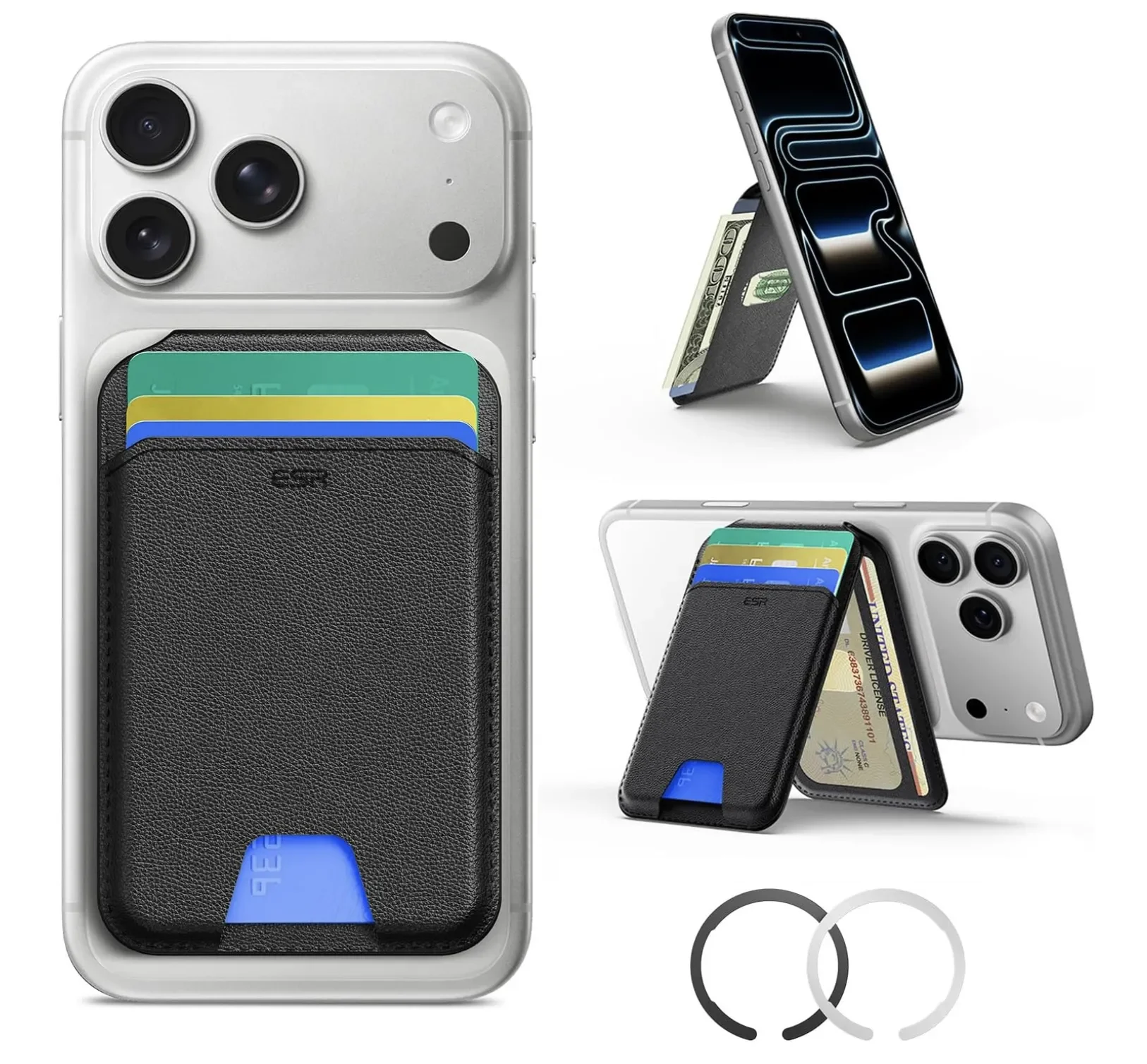
If you don't care about a tracker, the ESR Aura at around $28 (about $40 list) is the value champion. Five slots, an ID window, a stand, vegan leather. No Find My of any kind, which is the whole reason it's cheap. For a lot of people that's a completely fair trade. The ID window is the sleeper feature here – if you flash a badge or a transit pass all day, leaving it visible instead of digging for it is a small daily win. I like to think of the Aura as the wallet you buy the relative who wants the one that just works and never wants to hear the word firmware.
My take: the most wallet you can get for the least money – if you don't need a tracker or real leather, just buy it and get on with your day.
Satechi Vegan-Leather Wallet Stand – Best Budget Stand Alternative
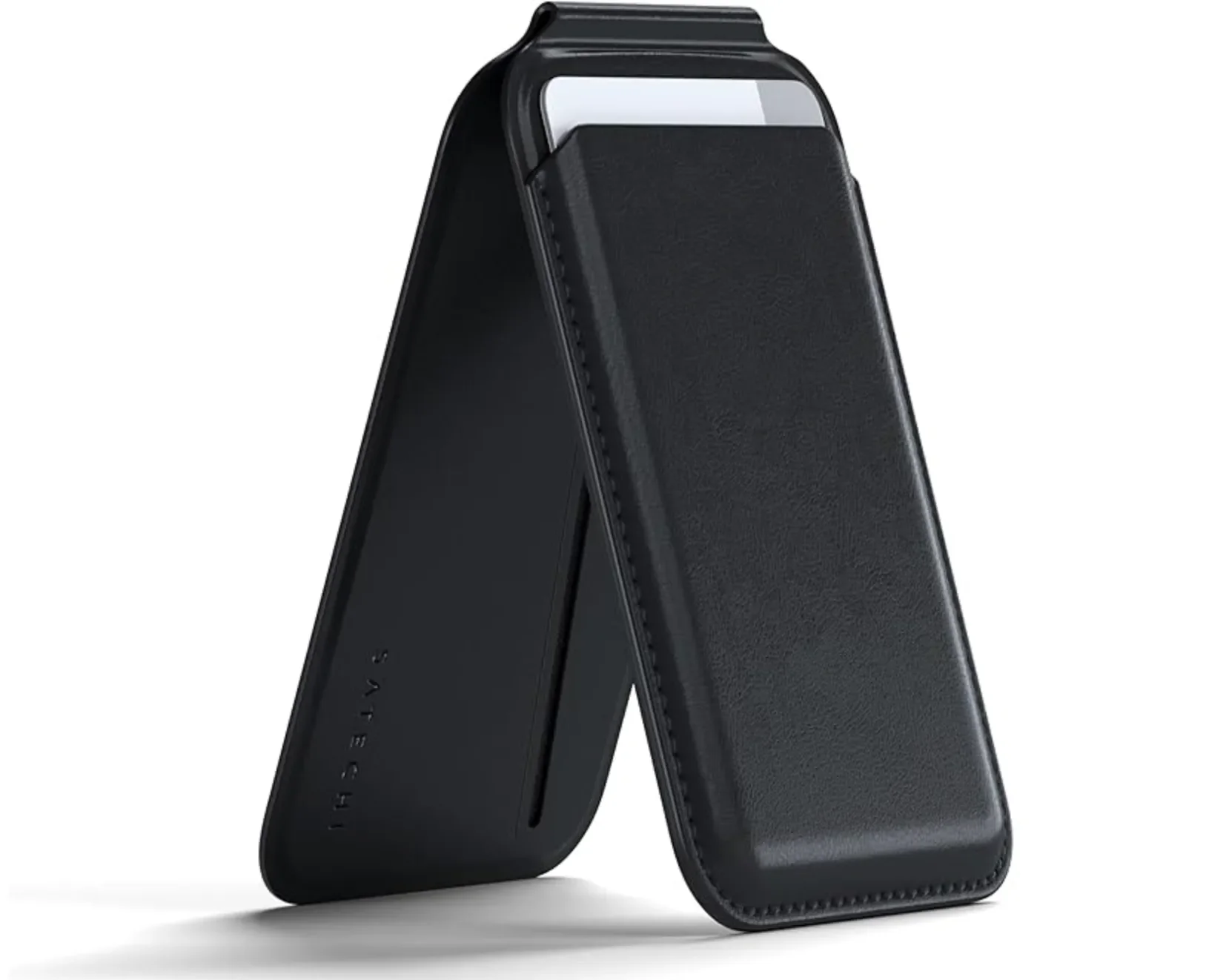
If the ESR Aura isn't your look, Satechi's wallet is the closest like-for-like. The Satechi Vegan-Leather Wallet Standis $39.99, holds up to four cards, and folds into a portrait or landscape stand, and the vegan leather looks the part – I like to single out the precise stitching and a proper metal hinge. The newer double-flap version adds the trick I like most: front NFC pass-through, so you can tap to pay without pulling a card out.
The trade-offs mirror the Aura's. There's no tracker of any kind, and at around 10.5 millimeters thick it's a touch chunkier than the slimmest picks, though Satechi rates it for a strong 900-gram magnetic grip.
My take: a fair-priced, good-looking stand wallet that earns its place on the NFC pass-through alone – take it over the Aura if tapping to pay through the wallet appeals to you.
Ekster Cardholder Pro – Best for Hoarders
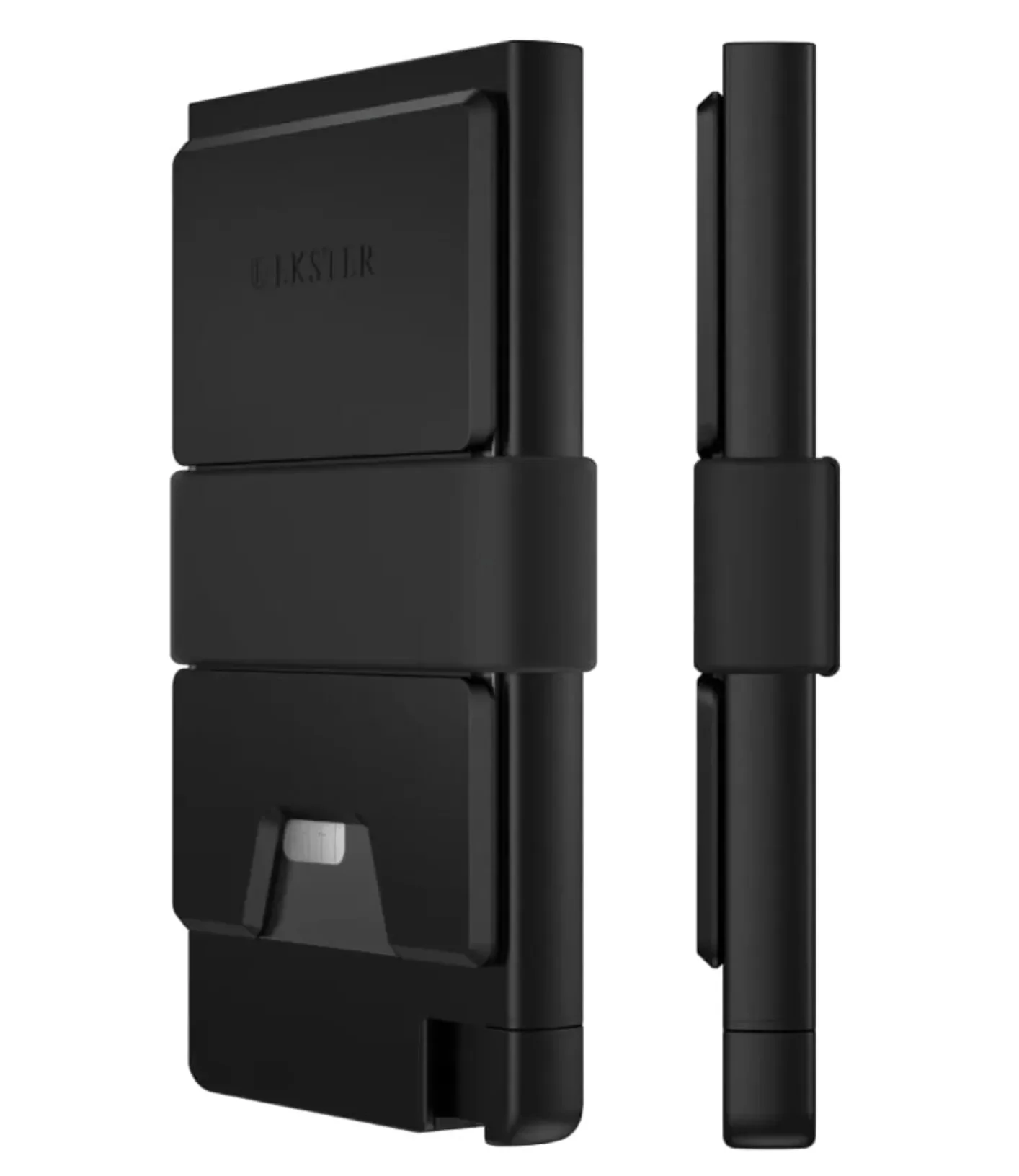
Finally, the outlier. Ekster's Cardholder Pro for MagSafe is $129, made of aluminum, and holds seven cards (more with accessories). Find My is an add-on Finder Card for around $59. It's overkill for most, but if you genuinely carry a stack of cards and want them to fan out at the press of a button, nothing else here competes. One nice touch if you're hard on your gear: Ekster's Finder Card is rated IPX5 water-resistant, which none of the others here can claim, and the aluminum body shrugs off the pocket abuse that turns fabric wallets ratty. It's the SUV of this group – heavier, pricier, and more than most people need, but built to take a beating.
My take: overkill for most people, but if you genuinely carry a thick stack of cards, nothing else here competes – the tank you buy once and beat up for years.
Native Find My vs. Rechargeable Tracker – They Are Not the Same Thing
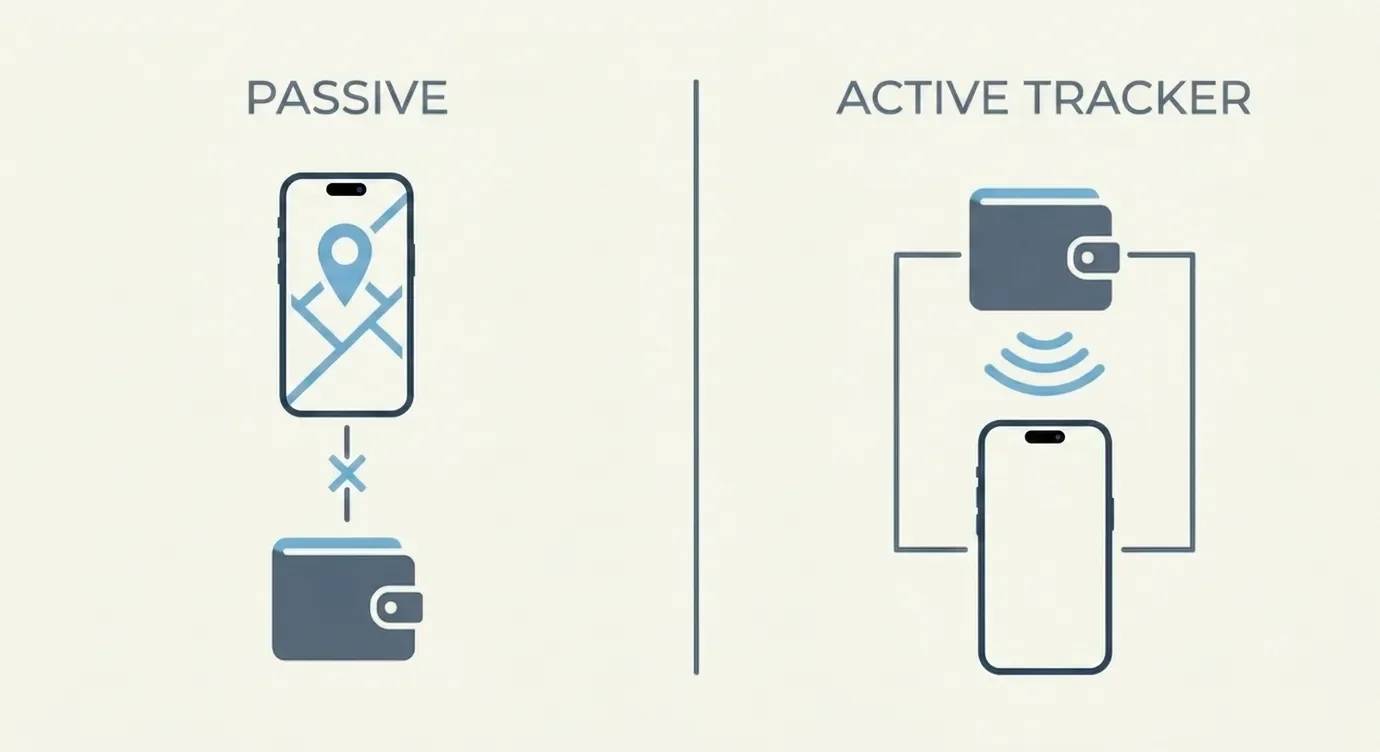
Apple's wallet has no battery and no active tracker. It uses an NFC chip so your iPhone logs the GPS point where the wallet was last detached, and that dot only updates if someone reattaches it to another iPhone. It will never show you where your wallet is right now.
Wallets from Nomad, ESR, and Ekster instead embed a rechargeable Bluetooth tracker that behaves like an AirTag – it pings the crowdsourced Find My network and can play a sound nearby – but it needs a top-up every few months.
I cannot overstate how often people misunderstand this. Apple’s wallet just notifies you when/where it was last attached to your iPhone. That's it. So if your nightmare is leaving your wallet on a train, Apple's version won't save you. A Nomad or ESR with a live tracker will. If your nightmare is just losing track of it around the apartment, Apple's passive approach is honestly fine, and you never have to charge it.
There's a money angle hiding in here, too. A standalone AirTag runs about $29, so a tracker wallet from Nomad or ESR effectively folds that cost in and saves you from clipping a plastic disc to your cards. Apple's wallet skips the recurring recharge entirely but hands you the weakest version of finding it. Pick your trade: a little upkeep for real tracking, or zero upkeep for a last-seen pin on a map.
Living with a Tracker Wallet (Yes, You Have to Charge It)
If you go the Nomad or ESR route, here's the honest day-to-day. Setup is painless – you add the wallet as an item in the Find My app, exactly like an AirTag, and you're done. The upkeep is the part people underestimate. Nomad's tracker recharges wirelessly on any pad, while the ESR Geo uses that proprietary USB-C pin, and both want a top-up every few months or the tracking quietly goes dark. I set a recurring reminder, because a tracker you forgot to charge is just dead weight with extra steps. If that already sounds like a chore you'll resent, that's a real point in Apple's favor – its no-battery wallet never asks anything of you.
How to Choose a MagSafe Wallet
Strip away the brands and it comes down to five questions.
Do you need live tracking? If yes, get a rechargeable-tracker wallet (Nomad, ESR Geo). If you just want a detach alert, Apple's native Find My is enough.
How many cards? Two to three is the honest ceiling for slim wallets. Need more? Look at ESR's five-slot designs or Ekster.
Material matters to you? Leather ages beautifully (Nomad). Vegan leather and textile are cheaper and lighter (ESR, Apple).
Want a stand? ESR's Geo, MOFT's Find My stand, and Satechi's wallet all build one in, and it's genuinely useful for video.
Naked phone or case? This one's underrated. A MagSafe wallet holds far better on a MagSafe-certified casethan on bare glass – more on that next.
If I had to crush all five into one sentence: decide how much you care about finding it and feeling it, and the price mostly sorts itself out. A minimalist who never loses anything should grab the cheap ESR Aura and get on with their day. Someone who has lost a wallet before – or just sleeps better knowing they can track it down – should pay up for the Nomad or ESR Geo. And if the phrase "recharge the wallet" makes you sigh out loud, well, that's Apple's entire pitch in a nutshell.
Do MagSafe Wallets Actually Fall Off?
Sometimes. And the variable that really makes a different is whether your phone is naked.
In my testing, every wallet held rock-solid when the phone wore a MagSafe case. On a bare phone, the bond is noticeably softer – fine sitting on a desk, sketchier when you're yanking the phone out of a tight pocket. I'm not alone here. And plenty of third-party magnets are weaker than Apple's to begin with. You'll see vendors throw around exact magnet "gauss" numbers, but those figures mostly come from marketing blogs and don't map cleanly to real holding strength – what matters is the roughly two to three pounds of pull a standard MagSafe array provides.
It's a common enough gripe that you'll find whole threads about it.
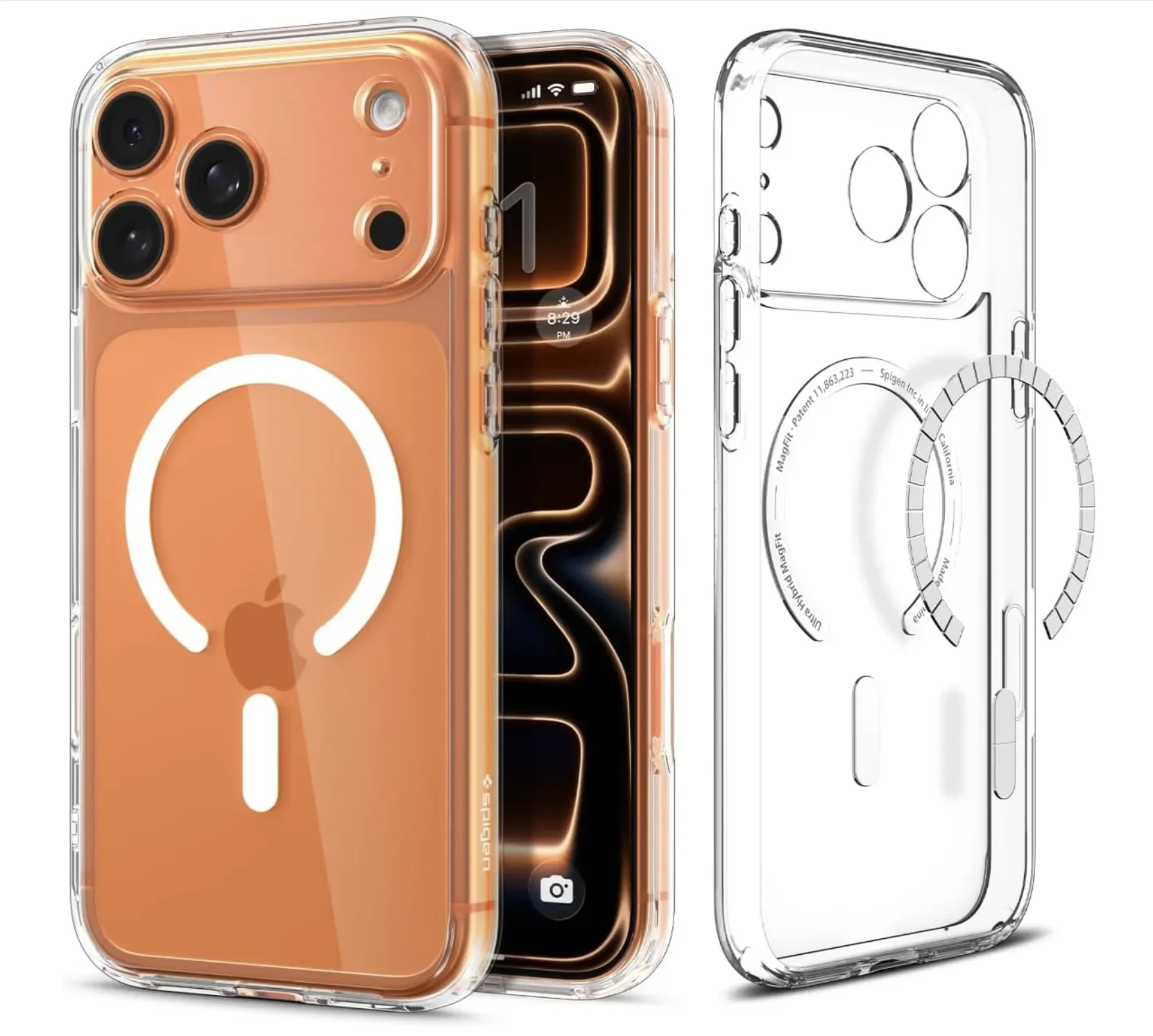
My rule of thumb: if you carry a wallet, put a real MagSafe case on the phone. The combination is the difference between "I forget it's there" and "I keep checking if it's still there." If you need one, the Spigen Ultra Hybrid MagFit is a cheap, clear case whose MagSafe ring grips a wallet far harder than bare glass does.
Are MagSafe Wallets Safe for Your Cards?
Mostly yes, with one asterisk.
Modern bank cards use high-coercivity magnetic stripes that are tough to wipe, and Apple says its wallet includes a shield that protects both standard and high-coercivity cards. The card-killing fear is largely overblown – Mashable's explainer reaches the same conclusion.
The asterisk: low-coercivity cards like hotel keys, gym fobs, and some office access badges are more vulnerable, so don't leave those pressed against the magnets.
I've never had any issues with all my cards (e.g. normal debit or credit cards) in almost five years. I just don't trust it with my building's access card. Treat that as the line.
A quick related note: you'll have to pull the wallet off to charge your phone wirelessly, since it sits right on the charging coil. After a week it becomes muscle memory.
Do You Actually Need RFID Blocking?
Nearly every MagSafe wallet brags about RFID blocking, so let's be real about it. For most modern bank cards, the skimming threat is largely overblown. Where blocking does earn its keep is closer to home: it stops the cards stacked on your phone from interfering with the phone's own NFC when you tap to pay. If Apple Pay has ever thrown a fit because a transit card was arguing with it through the wallet, that's the problem shielding quietly solves. Nice to have – not a reason to pick one wallet over another.
One Compatibility Exception
Almost every iPhone from the 12 onward has MagSafe, so any of these wallets will snap right on. The one exception is the budget line: the iPhone 16e shipped without MagSafe magnets and only does slow 7.5W Qi charging. Apple corrected course with the iPhone 17e, which supports MagSafe at 15W. If you're on a 16e, a MagSafe wallet won't reliably stick – that's the lone exception to know about.
Is the Apple MagSafe Wallet Still Worth It in 2026?
Here's my honest answer after living on both sides of it.
Worth it if you want the simplest possible Apple-ecosystem experience, you like that there's no battery to ever recharge, and a detach alert covers your definition of "finding" it. For a certain kind of buyer – minimal, all-in on Apple, allergic to fuss – the FineWoven wallet is still a clean, satisfying choice.
Skip it if you want any of the things the competition now does better: real leather that ages well (Nomad), live real-time tracking (Nomad or ESR Geo), a built-in stand (ESR), more than two comfortable card slots, or simply a lower price (ESR Aura at less than half the cost).
Let me make it concrete with the people who always ask me. The student who just wants cards on their phone and a price that doesn't sting? ESR Aura, done, keep the change. The content creator or commuter who films, takes calls, and would spiral if they lost their cards? ESR Geo, for the stand and the real tracker. The person who loved their old leather Apple wallet and misses it daily? Nomad, no hesitation. And the die-hard who buys every Apple accessory on principle? The FineWoven wallet will make you happy, and honestly, that's a fine reason on its own.
A few years ago I'd have told you to just buy the Apple one (real leather version) and move on. In 2026 I can't. The wallet I'd actually hand most people is the ESR – Aura if you're watching your wallet, Geo if you want the tracker and stand – with the Nomad as the splurge for anyone who wants leather they'll be glad to still be carrying in a few years. Apple's is the safe, slightly pricey default, not the best.
Whatever you pick, put it on a cased phone, keep your hotel keys out of it, and stop carrying a brick of a wallet in your back pocket. That part, at least, I'm certain about.
In the meantime, I want to know what's riding on the back of your phone right now and whether it has actually held on. Tell me your wallet, your card count, and any card it has quietly scrambled in the comments below – the oddball setups are usually where I learn the most.
And if you'd rather find out whether an Apple accessory earns its price before you hand over the cash, join my tech newsletter: every issue is a plain-English buy-or-skip call on the gear I've actually lived with, so you can dodge the ones I ended up regretting.
FAQ
-
Plan for two to three, whatever the box claims. Apple rates its wallet for three cards, but in my testing two sit comfortably and a third makes the magnet feel nervous. If you genuinely need more, ESR's five-slot designs or the seven-card Ekster are the only picks here built for a real stack.
-
Not well, at least not the slim ones. Most MagSafe wallets, Apple's included, are cut for cards and nothing else, so a few folded bills will bulge the back of your phone and soften the hold. If cash is non-negotiable, a roomier option like the ESR Aura's five slots gives you a little space to tuck a bill behind your cards.
-
No, treat them as splash-prone rather than waterproof. Apple publishes no water rating for its wallet, and leather like Nomad's especially won't thank you for a soaking. The lone exception sits inside a tracker: Ekster's Finder Card is rated IPX5, but that covers the add-on tracker, not the cards around it.
-
No. MagSafe is Apple's own magnetic standard, and the wallet's magnets are designed to sit against the back of the phone without harming it or the battery. The only catch is that the wallet covers the wireless charging coil, so you pull it off when you want to charge. Your cards are a separate question, which I dug into higher up.
-
No. Apple discontinued its leather wallet in 2023 and now sells only the FineWoven version, which is a woven textile rather than leather. If you want real leather that ages instead of fraying, a third-party option like the Nomad Leather Mag Wallet is the closest thing to what Apple used to make, and it folds in the live tracker Apple's leather wallet never had.
-
Usually not. A MagSafe wallet clings to the magnet ring Apple builds into iPhones, and most Android phones don't have one, so the wallet either slides off or won't attach unless you add a magnetic case. Even when it does stick, you lose Apple's Find My entirely, so any smart-tracking feature is dead weight on Android.






I sell Apple Pencils at a tech store every week, and this apple pencil comparison covers the exact questions customers ask before buying one.