
The Short Version
In the DeepSeek vs ChatGPT debate, ChatGPT is the better overall product in 2026, but DeepSeek is the better deal – near-frontier quality for a fraction of the price, as long as nothing you type is sensitive.
Best for:
- DeepSeek – when you want near-frontier quality for almost nothing, code at high volume, or self-host open weights, and nothing you type is private.
- ChatGPT – when you want images, voice, the most polished app, or real privacy controls for work and personal data.
When DeepSeek's R1 model dropped in January 2025, it briefly wiped hundreds of billions off US tech stocks because a Chinese lab had seemingly matched OpenAI for a fraction of the cost. I wrote about that moment on this blog back then. A year and a half later, the panic has settled, and we finally have two mature products to compare: DeepSeek V4 and ChatGPT running GPT-5.5 – released, I kid you not, one day apart in April 2026.
I've used ChatGPT daily for years. It's baked into how I research and draft outlines for this blog. So for the past two weeks, I ran DeepSeek through the exact same workload to see where each one actually wins.
DeepSeek vs ChatGPT Overview
| DeepSeek | ChatGPT | |
|---|---|---|
| Latest model | V4 Preview (Apr 24, 2026) | GPT-5.5 (Apr 23, 2026) |
| Made by | DeepSeek, owned by Chinese hedge fund High-Flyer | OpenAI (US) |
| Free tier | Full chat app, free, no ads | Limited messages, with ads in the US |
| Paid plans | None for the app (API is pay-per-token) | Go $8 · Plus $20 · Pro $200 per month |
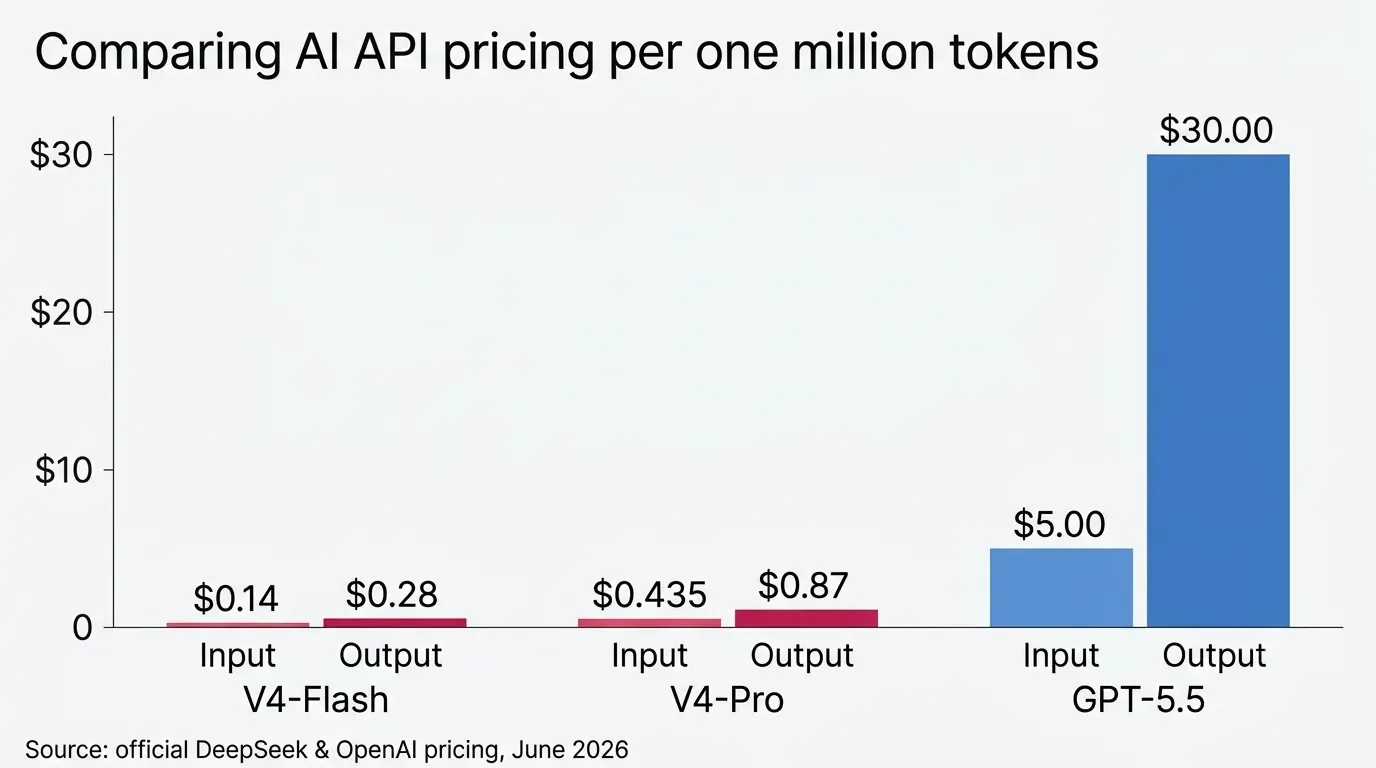
| API price (per 1M tokens in/out) | From $0.14 / $0.28 (Flash); $0.435 / $0.87 (Pro) | $5 / $30 (GPT-5.5) |
| Images & voice | No – text only | Yes, on all plans |
| Open source | Yes – MIT-licensed weights | No (flagship models are closed) |
| Where your data lives | Servers in China | US, with EU residency options for business |
| Best for | Developers, tinkerers, budget users | Everyday users, creators, businesses |
DeepSeek is an AI lab based in Hangzhou, China, founded in 2023 by Liang Wenfeng and owned and funded by High-Flyer, a Chinese quantitative hedge fund. Quick aside, because people search for this constantly: you cannot buy DeepSeek stock. It's a private company. There's no ticker, no IPO date, nothing.
The company became famous overnight in January 2025, when its R1 reasoning model matched far more expensive American models for a tiny fraction of their cost. The widely cited $6 million figure was actually the bill for training its V3 base model; DeepSeek later put R1's own training cost at just $294,000. The current lineup is the V4 Preview, released April 24, 2026: V4-Pro and the smaller V4-Flash, both with a 1-million-token context window, both free to use in the app.
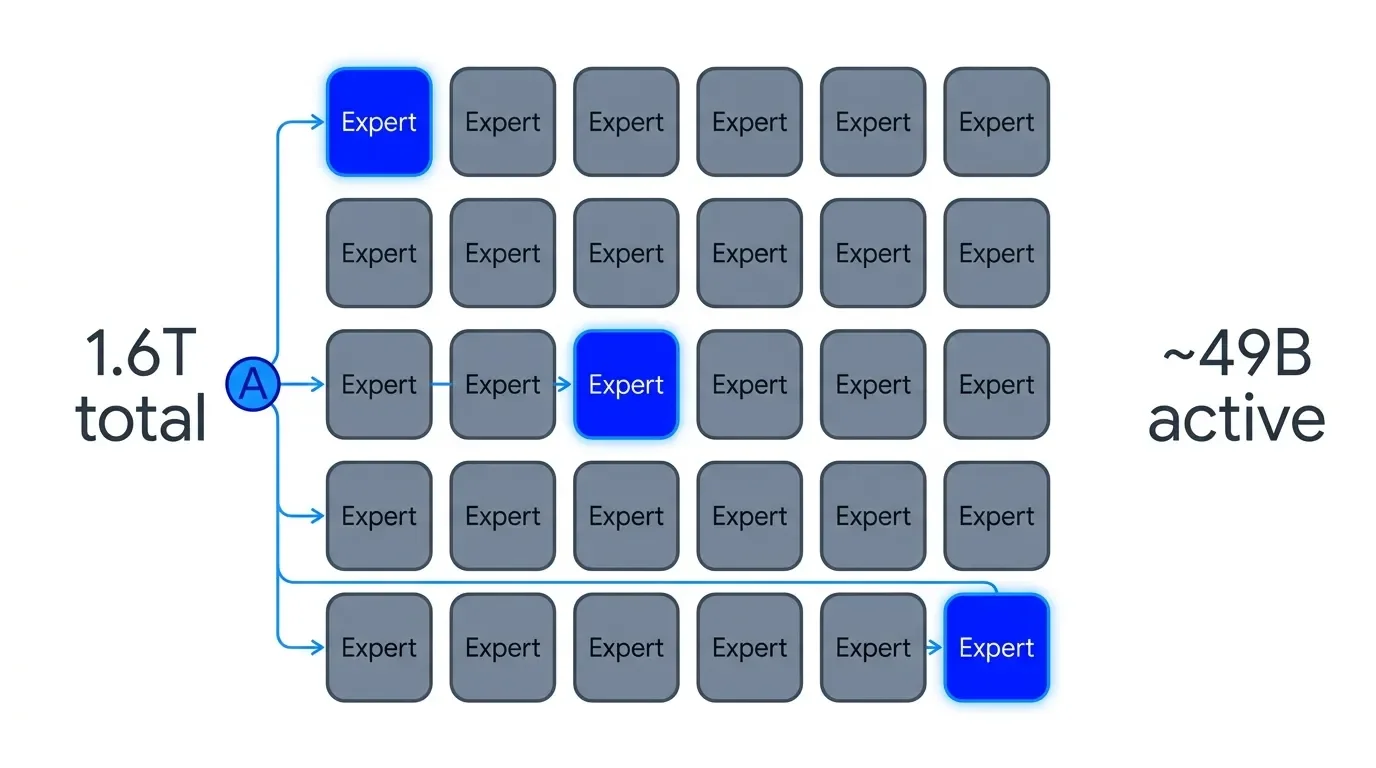
The headline number – 1.6 trillion parameters for V4-Pro – sounds absurd, but only about 49 billion of them activate per token, thanks to a mixture-of-experts design. I, as a pianist, like to think of it like a huge orchestra where only the musicians needed for the current bar actually play. It's also exactly why DeepSeek can afford to be this cheap.
What Is ChatGPT?
You know ChatGPT. Statistically, you used it this week – the app passed one billion monthly active users in May 2026, per Reuters. It's OpenAI's chatbot, currently running GPT-5.5, with the faster GPT-5.5 Instant as the default model since early May.
The bigger change for normal users came earlier this year: OpenAI now shows ads to free and Go-tier users in the US (plus Australia, New Zealand, and Canada). Paid tiers stay ad-free, and OpenAI insists ads don't influence answers. I spent three years studying the psychology of economic decision-making, so let's just say I have opinions about ad-funded answer engines. We'll get to that.
Reasoning & Accuracy
Here's the most honest framing I've found. In April 2026, the US NIST's Center for AI Standards and Innovation evaluated DeepSeek V4 Pro and concluded it lags the frontier by about eight months. Eight months. That's it. For drafting an email or explaining a contract clause, you will not feel that gap. For long, multi-step reasoning chains, you will.
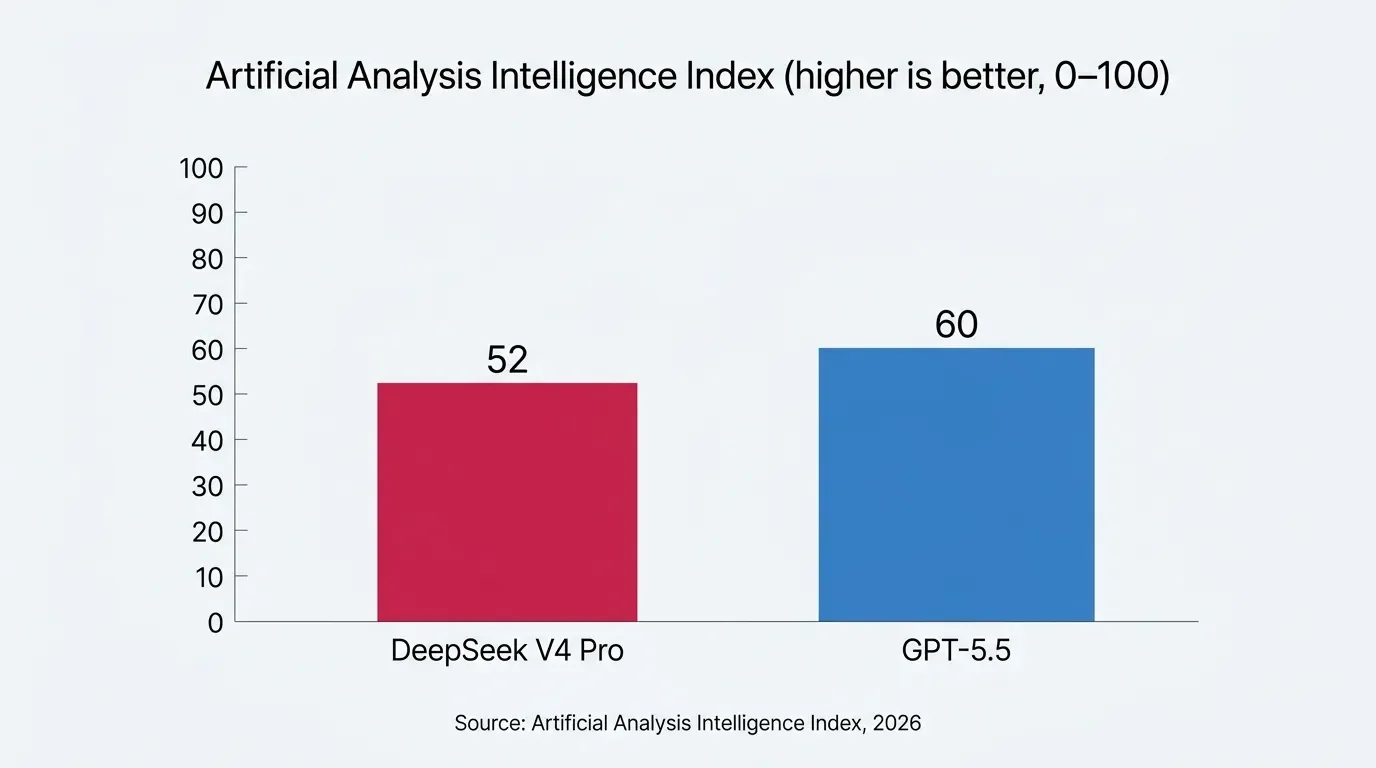
The independent numbers back this up. Artificial Analysis scores V4 Pro a 52 on its Intelligence Index – among the best open-weights models in the world, tied with Qwen 3.6 Preview and just behind Kimi K2.6 – while GPT-5.5 leads the independent ARC-AGI-2 leaderboard at 85%, a benchmark designed to be hard for machines. These are independent benchmarks, and the direction is consistent: ChatGPT reasons better at the high end.
The bigger practical difference is honesty about uncertainty. On Artificial Analysis's Omniscience benchmark, V4 almost never admits it doesn't know something – it just answers. I ran into this directly. While fact-checking a finance draft, DeepSeek handed me a tidy, confident statistic I could not verify anywhere. ChatGPT, asked the same thing, told me the data didn't exist in any source it could find. That difference matters a lot more than benchmark points when money or health is involved – and it's worth saying that OpenAI's claimed hallucination reductions in law, medicine, and finance are its own marketing until independently verified, too.
Coding
On paper, DeepSeek is a awesome here. Its own technical report claims 80.6% on SWE-bench Verified – vendor numbers, mind you. Independent leaderboards tell a messier story: Anthropic's Claude currently leads serious software-engineering benchmarks ahead of both, and crowdsourced rankings place V4 lower than its scores suggest. Benchmarks and vibes don't fully agree.
What barely anyone disputes is the economics. Developer forums are full of people reporting hours of heavy agentic coding for literal cents. My own test was small but real: I asked both to debug the custom CSS behind the HTML tables on this blog (Squarespace 7.1 makes you earn your formatting). Both fixed it. ChatGPT was a bit more careful about explaining why my selector broke. DeepSeek did it through the API for less than a cent.
If you write code for a living, the calculation is simple: DeepSeek for volume, a frontier model for the gnarly stuff.
Speed & Reliability
DeepSeek's 2025 reputation was "brilliant, when the server isn't busy." That's largely outdated. DeepSeek's own status page claims 99.45% web-chat uptime from February through May 2026 – roughly four hours of downtime a month. That figure is self-reported and hard to verify independently, so I'll go by my own experience: in two weeks of daily testing I hit exactly one slow patch. Annoying, not fatal.
ChatGPT has outages too, but OpenAI's infrastructure is simply more mature, and at a billion users it has to be. If your workflow cannot stop, ChatGPT is the steadier horse.
Privacy, Security & Data Location
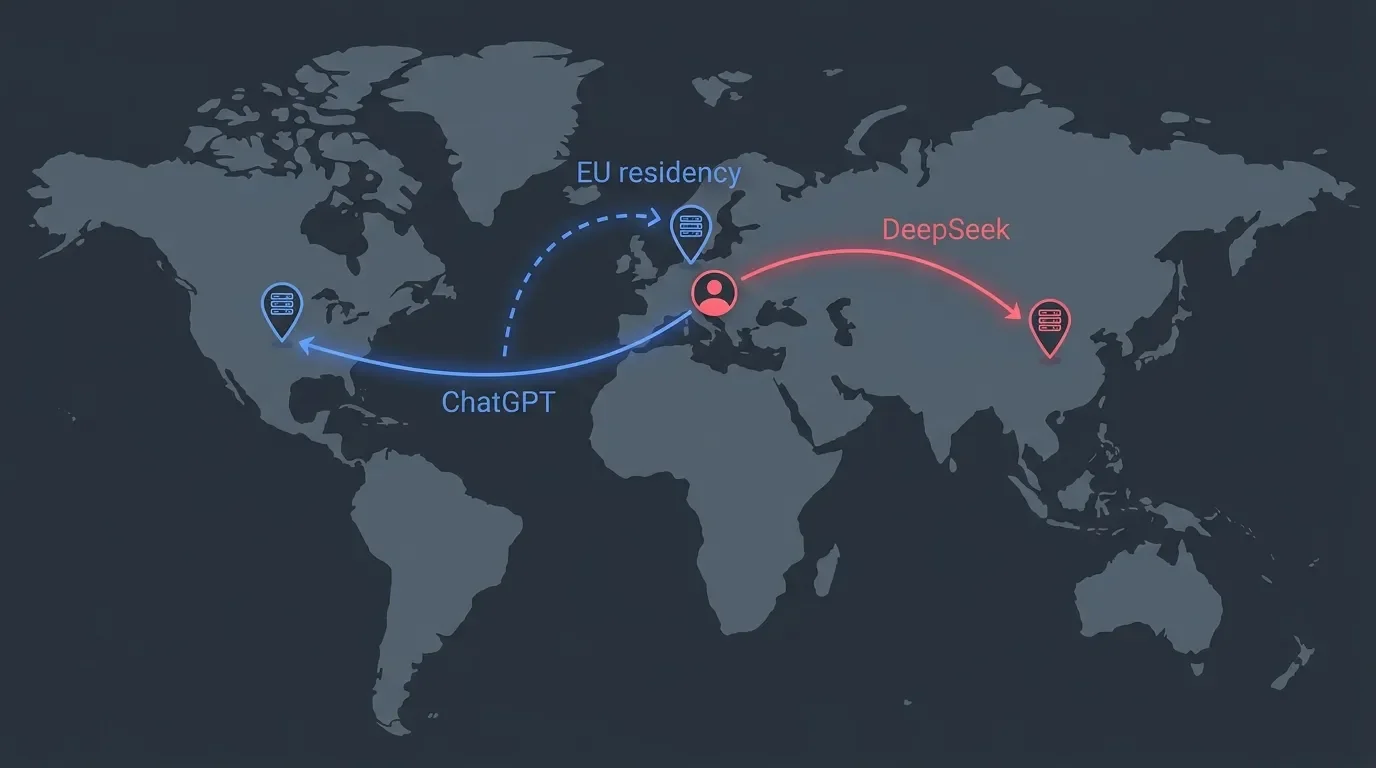
Six years of law school left me with a habit I can't shake: I actually read privacy policies. DeepSeek's is refreshingly blunt. The information it collects is stored on servers in the People's Republic of China, and disputes are handled under Chinese law. That single sentence explains most of what has followed: Italy's data-protection authority blocked the app, governments from Australia to the Czech Republic banned it on official devices, and US states like New York followed suit. Add an exposed database that leaked chat logs in early 2025, plus Anthropic's recent – and so far unproven – accusation of industrial-scale model distillation, and you get the picture: this is not the tool for anything you'd mind a stranger reading.
One genuinely important nuance: all of this applies to DeepSeek's hosted app and API. The open weights are a different story – run the model yourself and your data never leaves your machine. More on that below.
ChatGPT isn't automatically private either. On consumer plans, your chats can be used for training unless you opt out, and the new ads create a surface that didn't exist a year ago – though OpenAI says conversations stay private from advertisers. The difference is that OpenAI gives you levers: an opt-out toggle, no training on business data by default, and EU data residency for companies. With DeepSeek's app, the lever is in Hangzhou. I went deeper on how safe ChatGPT really is in a separate guide.
My rule of thumb: nothing goes into DeepSeek's app that I wouldn't write on a postcard. ChatGPT, with training opt-out enabled, handles the rest.
Pricing & Free Tiers
I think this is where DeepSeek stops being the underdog and starts being unfair.
DeepSeek
The web chat and mobile app are free, full stop – V4 included, no published message caps, no ads. The API runs $0.14 in / $0.28 out per million tokens for V4-Flash and $0.435 / $0.87 for V4-Pro, with cached input costing a tenth of that.
ChatGPT
Free comes with ads and tight limits – around 10 messages per five hours, per third-party trackers (OpenAI doesn't publish exact caps). Go is $8 with ads, Plus is $20 ad-free, and escaping limits entirely means the $200 Pro tier. The API costs $5 in / $30 out per million tokens – roughly 11x DeepSeek on input and 34x on output.
A fairness note from my psychology days: "free" is never free. With DeepSeek, you pay with your data going to China. With ChatGPT's free tier, you now pay with your attention. Pick your currency.
Open Source & Running DeepSeek Locally
This is DeepSeek's structural advantage. The V4 weights are published under an MIT license – anyone can download, inspect, fine-tune, or self-host them. OpenAI's flagships are closed; its gpt-oss models are a nice gesture, but they're not GPT-5.5.
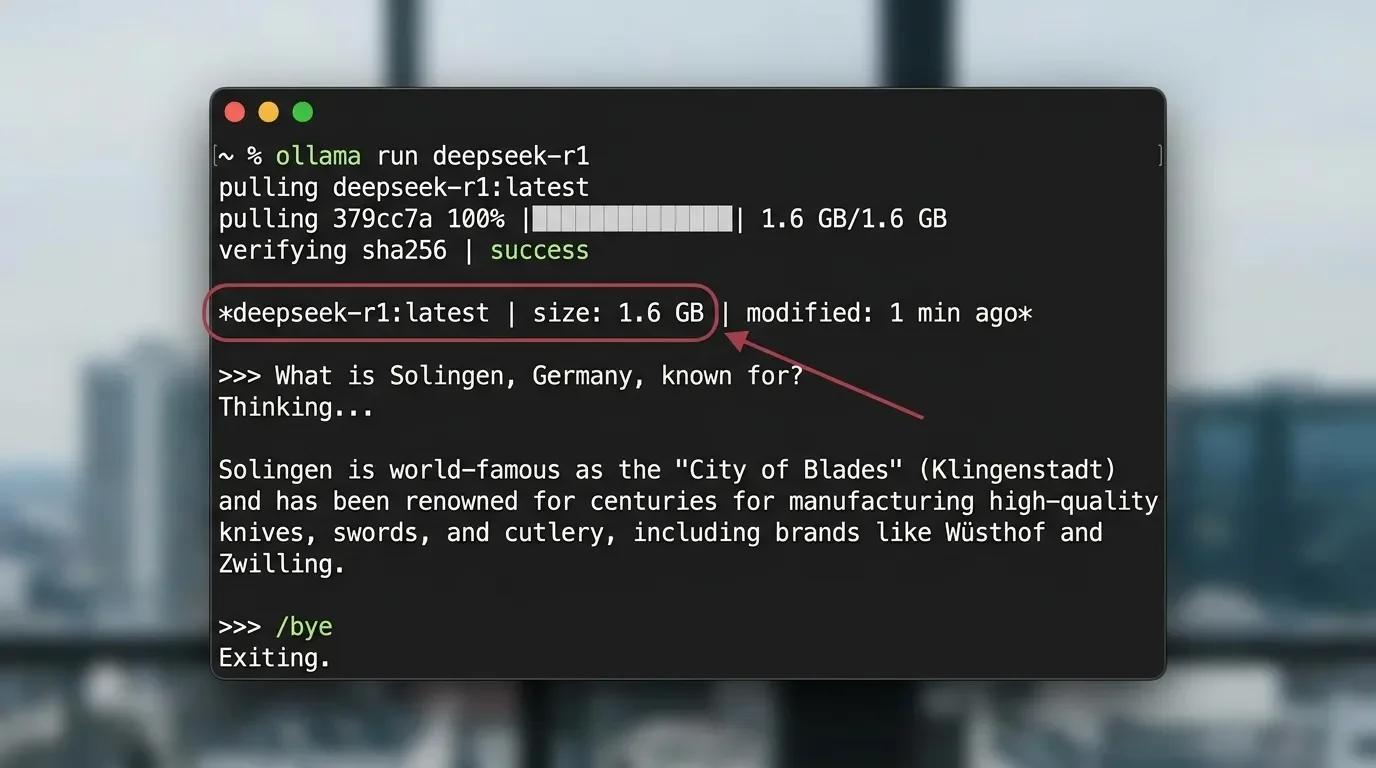
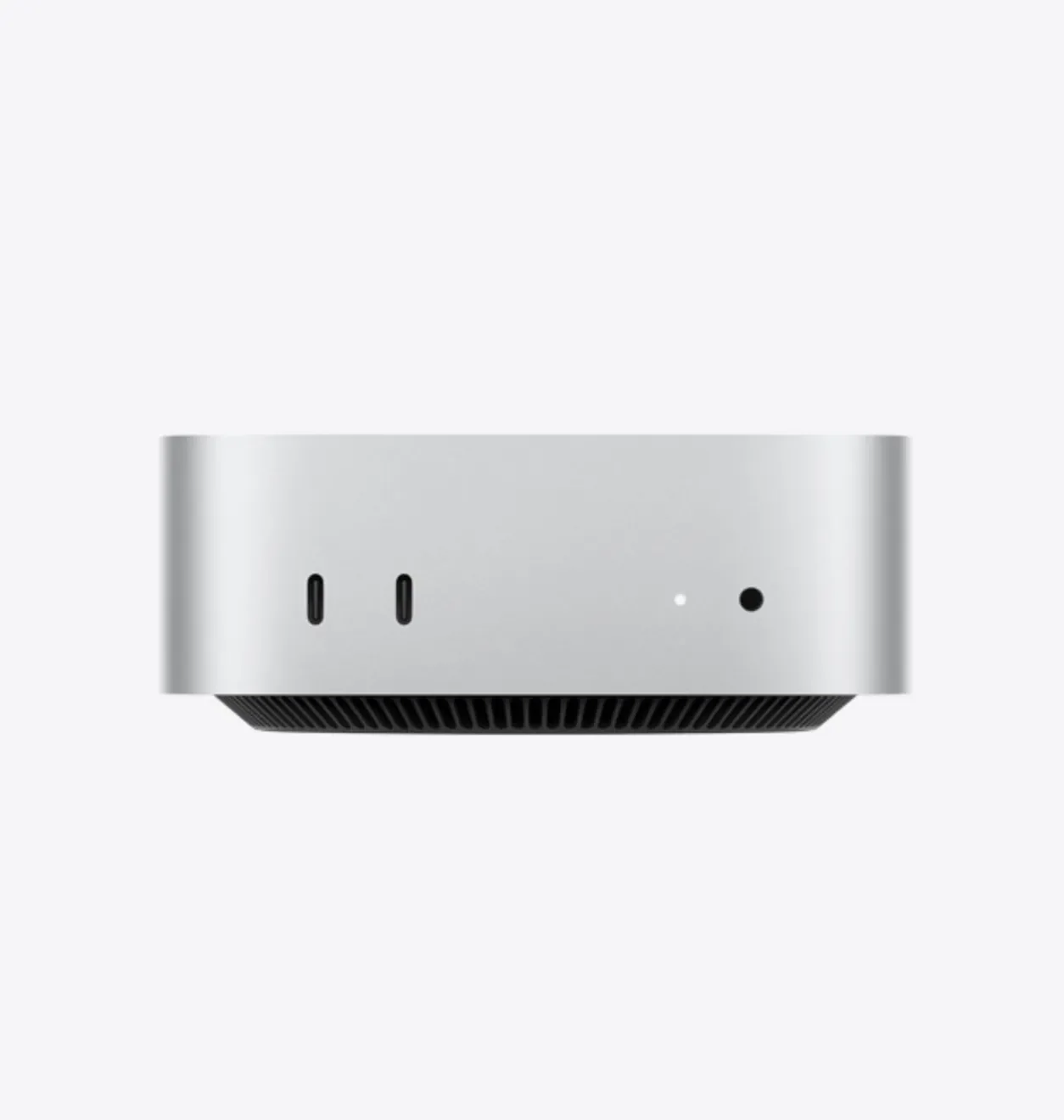
Let me kill a myth, though: you will not run the real DeepSeek at home. Full-size weights are hundreds of gigabytes and want server-class GPUs. What runs on a normal computer are the small distilled models – I pulled one onto my MacBook Pro 16” (M1 Max) via Ollama in about five minutes. It's noticeably dumber than the hosted version, and honestly more fun than useful. But it works offline, and nothing leaves your machine. If you want to push past the toy distills, the sweet spot is a machine with plenty of unified memory: a Mac mini with the M4 chip is the cheapest box I'd actually trust for local models (if you can still find one these days; preferably with as much RAM as possible), and because the weights eat disk space fast, I keep mine on a fast external SSD like the Samsung T9 rather than clogging the internal drive. There is no ChatGPT equivalent of that, at any price.
Features: Images, Web, Apps
Short section, because the comparison is lopsided (at least for now). DeepSeek V4 is text-only – no image generation, no voice mode. ChatGPT got Images 2.0 in April 2026 on every plan, plus voice, file analysis, and agent features.
For me this is a real workflow difference. I make my own blog hero images and YouTube thumbnails; with ChatGPT that lives in the same window as my drafting. With DeepSeek I'd need a second tool. If you create anything visual, this section alone might decide it.
My Take: Using Both for Real Work
For two weeks, everything I normally do with ChatGPT went through both: blog research, outlines, translation checks, code snippets.
What surprised me most was the writing. DeepSeek is smart, but its prose runs stiff – it explains things like a textbook that's slightly annoyed with you. For my German-to-English proofreading work, it translated accurately but kept missing register; it once turned a casual "du" email into something you'd send a tax office. ChatGPT reads the room better, and for someone who lives between two languages, that's not cosmetic.
What won me over anyway: the price of experimentation. Because DeepSeek's API costs almost nothing, I stopped rationing dumb questions. Batch-summarizing old posts for my rewrite project? Cents. A throwaway script to rename video files for DaVinci Resolve? Nothing. That freedom changes how you use AI more than a few benchmark points do.
So my setup after two weeks: ChatGPT stays my daily driver for writing, images, and anything touching client or personal data. DeepSeek became my background workhorse – bulk tasks, code, second opinions – and the thing I recommend to colleagues who refuse to pay for AI but keep hitting ChatGPT's free limits. Both stay on my phone. That's the honest review. If this kind of hands-on AI comparison is your thing and you want a smart, non-hyped framework for actually working with these tools, Co-Intelligence is the one book I'd hand a colleague.

Verdict: Which Should You Use?
Back in 2025, this blog asked whether DeepSeek would threaten US AI dominance. In 2026, the answer turns out to be: yes, but sideways. DeepSeek didn't dethrone ChatGPT – NIST says it's still about eight months behind, and the market barely flinched at V4. What it did was make near-frontier intelligence almost free, and force everyone – OpenAI included – to compete on price.
But in short:
Students and Budget Users
DeepSeek. A genuinely capable, unlimited, free assistant beats a rationed one with ads – just keep personal data out of it.
Developers
DeepSeek for API volume and self-hosting; a frontier model for the hardest problems. Your wallet will thank you.
Privacy-Conscious Users
ChatGPT with training opt-out – or, if you're technical, a locally-run open model. DeepSeek's hosted app is the worst option here by some distance.
Businesses
ChatGPT. Data residency, no-training defaults, and compliance paperwork exist for a reason; several governments have answered the DeepSeek question for you already.
Creators
ChatGPT. Images, voice, and drafting in one place is hard to give up.
For most people reading this: use ChatGPT. It's the more capable, more polished, more trustworthy product, and the $20 Plus tier is still the best mainstream AI deal going. If you build things, can't or won't pay, or believe open weights matter – DeepSeek is the most disruptive bargain in tech right now. Just know exactly what you're trading for it.
Both companies shipped their current flagships within 24 hours of each other, so the next leapfrog is probably already in training. I'll keep this post updated as it lands.
Your mileage will differ from mine, and I'd genuinely like to hear how. Are you running DeepSeek through the free app, the API, or locally, and what finally made you pick one over the other? Tell me about your setup in the comments below.
If you want more of these no-hype, hands-on breakdowns of which AI tools are actually worth your money (and which ones quietly sell your data), my tech newsletter sends one every time I finish a teardown like this one. You can subscribe here.




FAQ
-
Somewhat, but the core issue doesn't disappear. Anything sent to DeepSeek's hosted API still routes through servers in China, regardless of which app you use to access it. The only setup that truly keeps your data local is running the open weights yourself, as covered in the open-source section above.
-
Not for regular consumers, but it's increasingly restricted on government devices. Italy's regulator blocked the app for the general public in early 2025, and several governments and US states have barred it from official devices. For everyday personal use it remains available in most of the US and Europe, but check your employer's policy before installing it on a work phone.
-
Nobody can promise that, but the economics make it plausible for a while. The app is funded by a hedge fund and runs on an unusually cheap model architecture, which is exactly why the API pricing is a fraction of OpenAI's. I'd treat the free app as a generous current reality, not a permanent guarantee, and I wouldn't build a critical workflow on the assumption it never changes.
-
No. DeepSeek V4 is text-only in the app, with no image generation and no real vision or voice features at the time of writing. If you need to analyze a screenshot, edit a photo, or generate visuals, ChatGPT's Images 2.0 and file tools are the clear pick, as covered above.
-
For everyday questions, you probably won't notice. V4-Flash is the smaller, cheaper model and V4-Pro is the heavyweight; in my testing the gap only showed up on long, multi-step reasoning. For quick drafting, summaries, and simple code, Flash is fast and more than good enough, which is part of why DeepSeek's costs stay so low.
-
For most people who use AI seriously, yes. Plus gets you ad-free access, image generation, voice, and the more polished GPT-5.5 experience in one place, which DeepSeek simply can't match on features. If you only need a capable text assistant and don't mind keeping sensitive data out of it, the free DeepSeek app genuinely covers a lot of that ground for nothing.



I've used Gemini image generation almost daily for months. Here's how to create and edit images, what the free limits really are, and my best prompts.